The last ten day have been spent in preparing for the dissertation on November 1st. The theme for my trial lecture was received on October 18th – quite interesting theme, but also challenging and highly relevant. The committee has asked me to compare my findings to some phenomenon of the on-going national revision of the Early Childhood Teacher Education. This is the theme:
"The model of Negotiating Grasp as basis for a discussion of the distinction in the new Framework plan for early childhood teacher education (Forskrift om rammeplan for BA barnehagelærerutdanning) between the knowledge areas 'Children's development, play and learning' and 'Art, culture and creativity.' "
Here are some relevant links to web pages of The Oslo School of Architecture and Design, where the dissertation is taking place:
http://www.aho.no/no/AHO/Aktuelt/Kalender/2011/Disputas-Biljana-C-Fredriksen/
http://www.aho.no/no/FoU/Publikasjoner/Avhandlinger/Sammendrag-PhD/Biljana-Culibrk-Fredriksen/
http://www.aho.no/Global/Dokumenter/Nyhetsvedlegg/program_disputas_BCF.pdf
lørdag 29. oktober 2011

søndag 16. oktober 2011
My Sand Castle
It was the 4th of October and, for a few days, I had been expecting a mail from my dissertation committee. My step-son kept reminding me that a negative evaluation could still have some positive consequences and that I should think about them in order to prepare for the committee’s decision. The wise 13-year old was trying to prevent a large disappointment.
Instead of sitting and waiting at the internet café in Villarcayo, close to Nela village where my step-son, my son and a few friends were staying (the kids had one week off from school), we went to visit a place called San Vincent in Northern Spain. When we arrive to the beach, the sight was overwhelming; I’ve heard it was a nice place, but I did not expect to experience such a wonderful sight; The banded blue horizon reminded me that the Earth was round, and that it continued to spin around and around.
 While I was walking across the beach I enjoyed every moment; This day was finally my summer holiday – even though it was October, I did not have any real summer while I was rushing to finish my thesis. This was the little brake I was wishing for, for so many days… a cloud-free day before a storm…
My dissertation was built like a sand castle: I was carefully arranging each sand grain, adding water and pressing the flextible material with my hands. I imagined that the castle would stand up as a solid construction, but I still wanted the traces from my hands to remin visible - and the castle to appear as trustworthily vulnerable product of thousands of choices I had to take.
On the way back to Nela I checked my e-mail in Villarcayo: The response was positive! My sand castle did survive the storm… and the committee had understood that the “castle-builder” (they did not call me that) had “invested much of both her mind and heart in the inquiry”.
In a few days I will be receiving a theme to prepare for the trial lecture to be held on November the 1st. Today, Sunday 16th, I am enjoying another relaxing day – I think I deserve it...

Instead of sitting and waiting at the internet café in Villarcayo, close to Nela village where my step-son, my son and a few friends were staying (the kids had one week off from school), we went to visit a place called San Vincent in Northern Spain. When we arrive to the beach, the sight was overwhelming; I’ve heard it was a nice place, but I did not expect to experience such a wonderful sight; The banded blue horizon reminded me that the Earth was round, and that it continued to spin around and around.
 While I was walking across the beach I enjoyed every moment; This day was finally my summer holiday – even though it was October, I did not have any real summer while I was rushing to finish my thesis. This was the little brake I was wishing for, for so many days… a cloud-free day before a storm…
My dissertation was built like a sand castle: I was carefully arranging each sand grain, adding water and pressing the flextible material with my hands. I imagined that the castle would stand up as a solid construction, but I still wanted the traces from my hands to remin visible - and the castle to appear as trustworthily vulnerable product of thousands of choices I had to take.
On the way back to Nela I checked my e-mail in Villarcayo: The response was positive! My sand castle did survive the storm… and the committee had understood that the “castle-builder” (they did not call me that) had “invested much of both her mind and heart in the inquiry”.
In a few days I will be receiving a theme to prepare for the trial lecture to be held on November the 1st. Today, Sunday 16th, I am enjoying another relaxing day – I think I deserve it...

søndag 25. september 2011
Artistic Process as Pedagogical Text
The day I delivered the thesis (August 1st), I was back on the same teaching job I had before the PhD-study – however teaching is never the same. My main teaching responsibilities this fall are related to two groups of students: the one in a group of 18 undergraduate art and crafts students, the other is a group of 19 master degree students studying “pedagogical texts”. One might immediately wonder: What is a pedagogical text? Am I not an A&C teacher and how does my teaching relate to pedagogical texts? These questions are more than relevant at the point when both my students and I are searching for appropriate definitions of pedagogical text that can appropriately include arts-based approach to education.
 In the broad definition of “text”, as used by the researchers at Vestfold University College, a pedagogical texts is any kind of physical object that can be used in a pedagogical purpose. This, of course, includes text books, but also art materials, costumes used in drama education, or accordion used in music education. But what about a dance floor and the classroom space – are they also “pedagogical text” - or are they rather pedagogical contexts? Could anything used by a teacher in pedagogical purpose become a pedagogical text – disregarding what the pedagogical goals are? For instance, if the purpose of education is to stimulate students’ imagination, could a fairy-tale as well as a non-figurative sculpture, become a pedagogical text?
Meeting the two groups of my students, I bring with me my experiences and unanswered questions from one group to another; The group of A&C students have been exploring three-dimensional materials and reflecting about their experiences from the creative work. Many found it difficult to assign words to their aesthetic choices and intuitive actions. To inspire their future work with research on own creative work, artist-researcher Grete Refsum was invited to present her artistic processes.
 Listening to Grete Refsum I was thinking about how fantastic piece of pedagogical text her presentation was: It was a pedagogical text that seemed to have helped her structure her thoughts, past ideas, feeling and experiences in order to present them. On the other hand, her presentation was a well-functioning pedagogical text addressing the students and meeting them at the point they needed examples of well documented creative processes.
Grete presented her work with 17 pictures (part of the same art work) in chronological order: from the invitation to exhibit, exploration of the specific room shape and function, choices of the themes, materials, techniques, shapes, lines, compositions and so on. While she was talking and showing images, I got more aware of the complexity of her creative process – in fact I could identify at least four different processes that seemed to exist simultaneously, and interweave:
1. The process of studying the space, the physical contexts where her art would be exhibited; She seemed to have audience on her mind while she was planning.
2. The process of background research that supported her thematic choice of combining Western religion (Christianity) and Eastern (Kina) ideology and culture. This research would lead to her choices of symbols, materials, forms;
3. The process of exploring materials, techniques and practical possibilities of composing with the specific material combinations;
4. And the process of her traveling and collecting personal experiences one might think of as separated from her art, but in fact essential for it.
 When I view Grete’s lecture as a pedagogical text, I wonder where did such pedagogical text start and end; The lecture would not be possible if she had not for years worked on her art project, if she did not experience, reflect, take choices… Additionally, the pedagogical goals developed during her and mine discussion before the lecture about what the students needed. At this point, when the students got an assignment to verbalize their experiences and seemed to struggle with it, Grete’s lecture hopefully meet them at the right moment where they had experienced some challenge, but still not become too frustrated. Grete’s lecture could possibly help them to extent the zone of their proximal development, instead of giving up. This is up to them to evaluate: What do you say, my students?
Relevant link: International Association for Research on Texbooks and Educational Media (IARTEM)
 In the broad definition of “text”, as used by the researchers at Vestfold University College, a pedagogical texts is any kind of physical object that can be used in a pedagogical purpose. This, of course, includes text books, but also art materials, costumes used in drama education, or accordion used in music education. But what about a dance floor and the classroom space – are they also “pedagogical text” - or are they rather pedagogical contexts? Could anything used by a teacher in pedagogical purpose become a pedagogical text – disregarding what the pedagogical goals are? For instance, if the purpose of education is to stimulate students’ imagination, could a fairy-tale as well as a non-figurative sculpture, become a pedagogical text?
Meeting the two groups of my students, I bring with me my experiences and unanswered questions from one group to another; The group of A&C students have been exploring three-dimensional materials and reflecting about their experiences from the creative work. Many found it difficult to assign words to their aesthetic choices and intuitive actions. To inspire their future work with research on own creative work, artist-researcher Grete Refsum was invited to present her artistic processes.
 Listening to Grete Refsum I was thinking about how fantastic piece of pedagogical text her presentation was: It was a pedagogical text that seemed to have helped her structure her thoughts, past ideas, feeling and experiences in order to present them. On the other hand, her presentation was a well-functioning pedagogical text addressing the students and meeting them at the point they needed examples of well documented creative processes.
Grete presented her work with 17 pictures (part of the same art work) in chronological order: from the invitation to exhibit, exploration of the specific room shape and function, choices of the themes, materials, techniques, shapes, lines, compositions and so on. While she was talking and showing images, I got more aware of the complexity of her creative process – in fact I could identify at least four different processes that seemed to exist simultaneously, and interweave:
1. The process of studying the space, the physical contexts where her art would be exhibited; She seemed to have audience on her mind while she was planning.
2. The process of background research that supported her thematic choice of combining Western religion (Christianity) and Eastern (Kina) ideology and culture. This research would lead to her choices of symbols, materials, forms;
3. The process of exploring materials, techniques and practical possibilities of composing with the specific material combinations;
4. And the process of her traveling and collecting personal experiences one might think of as separated from her art, but in fact essential for it.
 When I view Grete’s lecture as a pedagogical text, I wonder where did such pedagogical text start and end; The lecture would not be possible if she had not for years worked on her art project, if she did not experience, reflect, take choices… Additionally, the pedagogical goals developed during her and mine discussion before the lecture about what the students needed. At this point, when the students got an assignment to verbalize their experiences and seemed to struggle with it, Grete’s lecture hopefully meet them at the right moment where they had experienced some challenge, but still not become too frustrated. Grete’s lecture could possibly help them to extent the zone of their proximal development, instead of giving up. This is up to them to evaluate: What do you say, my students?
Relevant link: International Association for Research on Texbooks and Educational Media (IARTEM)
søndag 28. august 2011
Attuning Tools, Materials and Muscles
An incredible project of reconstructing a Viking ship is taking place in Tønsberg at the moment (see http://www.osebergvikingskip.no/eng/) and is expected to take another autumn, winter and spring. The original ship called Oseberg, made by Vikings around the year 820, and later berried in Tønsberg area, is today exhibited at the Viking museum in Oslo.
 The same ship has been reconstructed before, but this time not only the ship is being copied, but the entire process of building it. The building process is shaped by knowledge about Vikings’ tools and techniques; knowledge about wood’s diverse qualities, as well as how it might have been affected by climate during the centuries of growing; knowledge about the ship’s lines, curves, joints, surface; hydrodynamic, waterproof and other qualities, and much more. In short, the reconstruction of the full size replica is a huge multidisciplinary project that calls on complex combinations of knowledge and expertise. Additionally, local knowledge is constantly being produces in here-and-now situations where physical work challenges craft-men and volunteers to master the tools and approach the materials (wood, iron or wool) in contextually appropriate manners. This means that they have to pay close attention to the exact qualities of the wood piece they have in hand, they have to adjust their movements according to the material, tool and muscles in their bodies… and to accomplish some kind of harmony between embodied knowledge, reflection and imagination in order to solve emerging problems - for instance: how to change axe’s angles when cutting across a 70 cm thick oak.
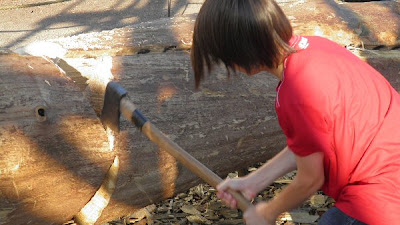 I am telling this from my personal experience. Usually I use saw to cut wood, but Vikings did not have saws. Cutting wood "the Viking-way" seemed easy when we were shown how to do it; doing it oneself was a quite different experience – I am sure it was also different experience for each of us (my three 13 years old companions and me) who volunteered that day.
I experienced how important it was to keep changing the angle of the blade in order to make a “V”-like shape (or rather “U”-shape, as learned through experience) through the wood; I experienced how loose I should hold around the handle in order to prevent hurting my wrists; which back muscles to engage; in which position to drop the axe; how to slide my hands along the handle in order to control to blade’s direction; how to find the right rhythm to provide the best efficiency, and so on… Each of the boys seemed to explore their own cutting technique, for instance banding and straitening knees in order to canalise power from feet up to the axe’s blade. They generally gave the most they had, claiming that they were not tired, but the following days, I’ve heard, the experience left some noticeable traces in their bodies – nothing permanent, but something to help them remember.
If cutting with an axe was our daily occupation, as it was for many Vikings, we would have to listen to our bodies much better – we would have to learn how to attune the bodies, tools and materials as perfectly as possibly. We would have to learn much, much more…
 The same ship has been reconstructed before, but this time not only the ship is being copied, but the entire process of building it. The building process is shaped by knowledge about Vikings’ tools and techniques; knowledge about wood’s diverse qualities, as well as how it might have been affected by climate during the centuries of growing; knowledge about the ship’s lines, curves, joints, surface; hydrodynamic, waterproof and other qualities, and much more. In short, the reconstruction of the full size replica is a huge multidisciplinary project that calls on complex combinations of knowledge and expertise. Additionally, local knowledge is constantly being produces in here-and-now situations where physical work challenges craft-men and volunteers to master the tools and approach the materials (wood, iron or wool) in contextually appropriate manners. This means that they have to pay close attention to the exact qualities of the wood piece they have in hand, they have to adjust their movements according to the material, tool and muscles in their bodies… and to accomplish some kind of harmony between embodied knowledge, reflection and imagination in order to solve emerging problems - for instance: how to change axe’s angles when cutting across a 70 cm thick oak.
 I am telling this from my personal experience. Usually I use saw to cut wood, but Vikings did not have saws. Cutting wood "the Viking-way" seemed easy when we were shown how to do it; doing it oneself was a quite different experience – I am sure it was also different experience for each of us (my three 13 years old companions and me) who volunteered that day.
I experienced how important it was to keep changing the angle of the blade in order to make a “V”-like shape (or rather “U”-shape, as learned through experience) through the wood; I experienced how loose I should hold around the handle in order to prevent hurting my wrists; which back muscles to engage; in which position to drop the axe; how to slide my hands along the handle in order to control to blade’s direction; how to find the right rhythm to provide the best efficiency, and so on… Each of the boys seemed to explore their own cutting technique, for instance banding and straitening knees in order to canalise power from feet up to the axe’s blade. They generally gave the most they had, claiming that they were not tired, but the following days, I’ve heard, the experience left some noticeable traces in their bodies – nothing permanent, but something to help them remember.
If cutting with an axe was our daily occupation, as it was for many Vikings, we would have to listen to our bodies much better – we would have to learn how to attune the bodies, tools and materials as perfectly as possibly. We would have to learn much, much more…
fredag 19. august 2011
Objects' Affordances
 With wide number of qualities, objects around us afford us with different possibilities. Some objects are designed to function in specific ways (like chairs or cars), while natural objects and materials do not have any pre-assigned meanings – it is up to each of us to interpret possibilities embedded in their forms.
 Qualities of an object can remind us of something else, thus, as well-behaving adults we would seldom wear a bucket. To be able to see possibilities in objects that already have preserved pre-assigned functions one needs to release imagination – and have self-confidence.
 Some objects, textures or shapes remind us of something we’ve earlier experienced. See for instance how 13-year old William found similarities between a round shape of a branch and a glass: He grasped the possibility in the material, imagined its possible function and carved a glass-holder. See also how he used old pants to make back-support on the chair he designed and crafted by himself.
lørdag 13. august 2011
Intersubjectivity of Grief
Intersubjectivity is an ability to “attune” to others, to communicate without words. Stern (2003) says that intersubjectivity develops from the earliest interactions between an infant and an adult when they share attention, intentions and emotional conditions. This means that babies can communicate long before they can talk – but it can also mean that ability to intersubjectively connect with others is integrated in each of us, though we might not be aware of it.
 During my interactions with 3-5 years old children it became so obvious for me how intuitive and embodied communication between us was, and how easily young children sensed my feelings and attitudes.
After the terror on July 22nd, people in Norway started to gather in different ways, with and without flowers, candles and torches. Such gatherings were different from any other contexts we’ve experienced. I wonder how we knew how to behave in appropriate ways?
 Once about 300 of us gathered in a theatre, we could observe a woman, hand in hand with a young man, entering the stage. When they stopped, she spoke to us while he remained silent - with grief on his face. They walked again towards a table with candles. We could now imagine what was going to happen, still none conducted us to rise simultaneously n the moment the candles were lightened; None told us to stand there in complete silence - but we all did. There were no prescriptions to follow – it was amazing how we attuned to each other’s movements, invisible gestures, breath, gaze… as if we were fishes in a stream. I don’t know how fishes do it, but I experienced intensive attention of all of my senses – I felt like a huge satellite dish antenna seeking to capture some signs from the surroundings, and my actions emerged from the inside before I had time to reflect about them - I was not thinking through verbal means of thinking, but through my body.
I guess we are all able to “match other people’s moods and emotions because of our ability to ‘read’ the form, the vitality, and the intensity of their movements” (Herskind, 2008, p. 280). However, when emotions are strong and shared, when the participants are attentive and the reason for their gathering exactly the urge to share with each other’s, our apparently hidden intersubjective abilities can surprise us with their intensity.
Herskind, M. (2008). Movement analysis and identification of learning processes. In T. Schilhab, M. Juelskjær & T. Moser (Eds.), Leraning bodies (pp. 269-283). Copenhagen: Danmarks Pædagogiske Universitetsforlag.
Stern, D. N. (2003). Spebarnets intersubjective verden [The Interpersonal World of the Infant] (Ø. Randers-Pehrson, Trans.). Oslo: Gyldendah Akademisk.
The images show a sea of flowers in Oslo and a gathering of 10 000 people in Tønsberg.
 During my interactions with 3-5 years old children it became so obvious for me how intuitive and embodied communication between us was, and how easily young children sensed my feelings and attitudes.
After the terror on July 22nd, people in Norway started to gather in different ways, with and without flowers, candles and torches. Such gatherings were different from any other contexts we’ve experienced. I wonder how we knew how to behave in appropriate ways?
 Once about 300 of us gathered in a theatre, we could observe a woman, hand in hand with a young man, entering the stage. When they stopped, she spoke to us while he remained silent - with grief on his face. They walked again towards a table with candles. We could now imagine what was going to happen, still none conducted us to rise simultaneously n the moment the candles were lightened; None told us to stand there in complete silence - but we all did. There were no prescriptions to follow – it was amazing how we attuned to each other’s movements, invisible gestures, breath, gaze… as if we were fishes in a stream. I don’t know how fishes do it, but I experienced intensive attention of all of my senses – I felt like a huge satellite dish antenna seeking to capture some signs from the surroundings, and my actions emerged from the inside before I had time to reflect about them - I was not thinking through verbal means of thinking, but through my body.
I guess we are all able to “match other people’s moods and emotions because of our ability to ‘read’ the form, the vitality, and the intensity of their movements” (Herskind, 2008, p. 280). However, when emotions are strong and shared, when the participants are attentive and the reason for their gathering exactly the urge to share with each other’s, our apparently hidden intersubjective abilities can surprise us with their intensity.
Herskind, M. (2008). Movement analysis and identification of learning processes. In T. Schilhab, M. Juelskjær & T. Moser (Eds.), Leraning bodies (pp. 269-283). Copenhagen: Danmarks Pædagogiske Universitetsforlag.
Stern, D. N. (2003). Spebarnets intersubjective verden [The Interpersonal World of the Infant] (Ø. Randers-Pehrson, Trans.). Oslo: Gyldendah Akademisk.
The images show a sea of flowers in Oslo and a gathering of 10 000 people in Tønsberg.
onsdag 3. august 2011
The Point of No Return
 The thesis was finished on Sunday morning, the last day of my three-year long full-time study. It was printed late in the evening, copied five times on Monday morning and personally delivered to my advisor Martina Keitsch in Oslo in the noon. I suppose that three of the examples are on their way to committee members: Marte Gulliksen, Michael Parsons and Halina Dunin-Woyseth. How it goes from here, is not up to me any longer…
 The thesis has been titled “Negotiating Grasp: Embodied Experience with Three-dimensional Materials and the Negotiation of Meaning in Early Childhood Education”. An article based on the thesis has been published in the digital journal FORMakademisk. The article presents a few examples of children’s interactions with 3D-materials and suggests that children’s creative ideas come from interactions between their past and present experiences.
mandag 11. juli 2011
Meeting the Audience
Who are you and why would you want to read my blog?
I can only imagine what could hold you attention on these lines, and can only try to satisfy your expectations. Thus, you are not one single person with unified needs… and I also have my wishes, agendas and power to choose which words to serve you. We, a writer and a reader, find ourselves in apparently simple relationship where you can click me away whenever you find the blog boring, annoying or uninteresting. On the other hand, this dialog is complex because I really need to connect with you (in my imagination) in order to write at all.
 I attended InSEA’s 33rd world congress in Budapest June 27th to 30th. Listening to many presenters made me wonder how they imagined their audience when they prepared their talks: Who were the people at the conference? What could they find worth listening? Preparing my own (18 minutes’) talk I was concerned with how to be short enough, but still say enough that the audience would understand.
 The presentation I found the most engaging, perfectly planned and carried out, was made by Sara Calcagnini from Leonardo DaVinci - National Museum of Science and Technology, in Milano. She spoke about symbiotic relationship between art and science.
Sara’s presentation started with relevant (and short enough) introduction including a self-ironic comment about her Italian English: she said this in a funny way, but saying that she was willing to humiliate herself for the sake of the message she wanted to share also had an strong, serious effect. With her honest and friendly appearance she quickly established contact with her audience and treated us with prudence and respect (at least this is what I experienced).
 Sara was completely engaged in her talk, believing with her whole body that she had something important to say. The images can give impression of her rapid movements addressing the audience and how her body language undeniably expressed her wish to motive us. Constantly providing with new insights, her talk had escalating dramaturgy, finally culminating with a call for help. And her call touched me. I felt connected. I was her audience - she moved me and motivated me.
 While I was thinking: “what a fantastic talk; what I fantastic person”, the first comment she received from the audience shocked me! The comment's irrelevance spoke of ignorance toward the important issues Sara addressed in her talk; She spoke about holistic understanding of our world and responsibility of global citizens. Don’t audience also have responsibility to contribute in constructive ways? Or remain silent…
I feel responsible that I did not stand up and give her my support. I am trying to convince myself that the majority of the audience felt like I did – but I don’t know. Was it possible that many of us did not grasp her powerfull message?!
I keep thinking about how important response from my audience is for me, both after a talk is over, but also before, and most of all while I am moving in front of them, trying to catch their eyes and looking for signs of acknowledgement, respect and interest.
We should not forget our audience, but they should also know how much they mean…
I can only imagine what could hold you attention on these lines, and can only try to satisfy your expectations. Thus, you are not one single person with unified needs… and I also have my wishes, agendas and power to choose which words to serve you. We, a writer and a reader, find ourselves in apparently simple relationship where you can click me away whenever you find the blog boring, annoying or uninteresting. On the other hand, this dialog is complex because I really need to connect with you (in my imagination) in order to write at all.
 I attended InSEA’s 33rd world congress in Budapest June 27th to 30th. Listening to many presenters made me wonder how they imagined their audience when they prepared their talks: Who were the people at the conference? What could they find worth listening? Preparing my own (18 minutes’) talk I was concerned with how to be short enough, but still say enough that the audience would understand.
 The presentation I found the most engaging, perfectly planned and carried out, was made by Sara Calcagnini from Leonardo DaVinci - National Museum of Science and Technology, in Milano. She spoke about symbiotic relationship between art and science.
Sara’s presentation started with relevant (and short enough) introduction including a self-ironic comment about her Italian English: she said this in a funny way, but saying that she was willing to humiliate herself for the sake of the message she wanted to share also had an strong, serious effect. With her honest and friendly appearance she quickly established contact with her audience and treated us with prudence and respect (at least this is what I experienced).
 Sara was completely engaged in her talk, believing with her whole body that she had something important to say. The images can give impression of her rapid movements addressing the audience and how her body language undeniably expressed her wish to motive us. Constantly providing with new insights, her talk had escalating dramaturgy, finally culminating with a call for help. And her call touched me. I felt connected. I was her audience - she moved me and motivated me.
 While I was thinking: “what a fantastic talk; what I fantastic person”, the first comment she received from the audience shocked me! The comment's irrelevance spoke of ignorance toward the important issues Sara addressed in her talk; She spoke about holistic understanding of our world and responsibility of global citizens. Don’t audience also have responsibility to contribute in constructive ways? Or remain silent…
I feel responsible that I did not stand up and give her my support. I am trying to convince myself that the majority of the audience felt like I did – but I don’t know. Was it possible that many of us did not grasp her powerfull message?!
I keep thinking about how important response from my audience is for me, both after a talk is over, but also before, and most of all while I am moving in front of them, trying to catch their eyes and looking for signs of acknowledgement, respect and interest.
We should not forget our audience, but they should also know how much they mean…
søndag 26. juni 2011
Prolonged Engagement
Many of us are effective and productive, and we believe that we get more from life when we rush. When we hurry around we probably do get to see more glimpses of different places and people – and that’s fine, but are we able to experience the qualities of the moments as we live them (not only count them)?
I was thinking about life and what Stern (2004) says about present moment: that life is always lived in present here-and-now moment; that life is a constant flow of single moments – each of them experienced here-and-now. And each of them influencing future experiences and understandings – that is: if we are able of experiencing the moments we live.
I was thinking about art appreciation and what Armstrong (2000) says about prolonged engagement. There is always much more beyond the first glimpse of something.

I was thinking about research methods and how Bresler (2006) compares Armstrong’s perceptual contemplation to qualitative research: She says that we need to take the time we need to truly connect with what we are studying. Lingering caress is about achieving prolonged engagement with a studied phenomenon in order to grasp deeper understanding of it (Bresler, 2006). And even more, we can experience mutual absorption into the phenomenon we are studying (Bresler, 2006). It is through true engagement that our experiences can become lived, and that we can become to know something through our bodies.

Through prolonged presence inside a context, of for example interaction with children, we can happen to take part in production of “slow knowledge” (Clark 2010). Though, what happens between people is seldom experienced as slow or simple, but rather as complex systems where “multiple parts continuously and fluidly influence one another” (Thelen and Smith, 1994, p. 331) – that is exactly why it takes time to study processes, of for instance children’s meaning negotiation in order to grasp them holistically and contextually.
The images show Liora Bresler at Munch museum in Oslo http://www.munch.museum.no/?id=&mid=&lang=en . The second image has been manipulated to illustrate mutual absorption between Liora and Munch.
Armstrong, J. (2000). The intimate philosophy of art. London: Allen Lane The Pinguin Press.
Bresler, L. (2006). Toward connectedness: aesthetically based research. Studies in Art Education: A Journal of Issues and Research in Art Education, 48(1), 52-69.
Clark, A. (2010). Young children as protagonists and the role of participatory visual methods in engaging multiple perspectives. American Journal of Community Psychology, 46, 115-123.
Stern, D. N. (2004). The present moment in present moment in psychotherapy and everyday life. New York, London: W.W. Norton & Company.
Thelen, E. & Smith, L. B. (1994). A dynamic systems approach to the development of cognition and action. Cambridge: MIT Press
I was thinking about life and what Stern (2004) says about present moment: that life is always lived in present here-and-now moment; that life is a constant flow of single moments – each of them experienced here-and-now. And each of them influencing future experiences and understandings – that is: if we are able of experiencing the moments we live.
I was thinking about art appreciation and what Armstrong (2000) says about prolonged engagement. There is always much more beyond the first glimpse of something.

I was thinking about research methods and how Bresler (2006) compares Armstrong’s perceptual contemplation to qualitative research: She says that we need to take the time we need to truly connect with what we are studying. Lingering caress is about achieving prolonged engagement with a studied phenomenon in order to grasp deeper understanding of it (Bresler, 2006). And even more, we can experience mutual absorption into the phenomenon we are studying (Bresler, 2006). It is through true engagement that our experiences can become lived, and that we can become to know something through our bodies.

Through prolonged presence inside a context, of for example interaction with children, we can happen to take part in production of “slow knowledge” (Clark 2010). Though, what happens between people is seldom experienced as slow or simple, but rather as complex systems where “multiple parts continuously and fluidly influence one another” (Thelen and Smith, 1994, p. 331) – that is exactly why it takes time to study processes, of for instance children’s meaning negotiation in order to grasp them holistically and contextually.
The images show Liora Bresler at Munch museum in Oslo http://www.munch.museum.no/?id=&mid=&lang=en . The second image has been manipulated to illustrate mutual absorption between Liora and Munch.
Armstrong, J. (2000). The intimate philosophy of art. London: Allen Lane The Pinguin Press.
Bresler, L. (2006). Toward connectedness: aesthetically based research. Studies in Art Education: A Journal of Issues and Research in Art Education, 48(1), 52-69.
Clark, A. (2010). Young children as protagonists and the role of participatory visual methods in engaging multiple perspectives. American Journal of Community Psychology, 46, 115-123.
Stern, D. N. (2004). The present moment in present moment in psychotherapy and everyday life. New York, London: W.W. Norton & Company.
Thelen, E. & Smith, L. B. (1994). A dynamic systems approach to the development of cognition and action. Cambridge: MIT Press
tirsdag 7. juni 2011
Moving the Bricks Around
 I’ve got the feed-back on the thesis draft from my co-advisor (Liv Gjems) and reader (Ellen Marie Sæthre-McGuirk) – and you can imagine how I use my hours these days? Fortunately, I do not have to re-write too much or add some large parts, but rather take some bricks away, move them around and glue them better together. I also need to file the edges and smoothen out the surfaces, though my friend Nicola, with her native-English-competence, will be most responsible for the polishing.
 The plan is to send Nicola the thesis before June 25-th and get it back from her around the middle of July; Then fix the lay-out and deliver the thesis around August the 1-st. The fact is that my time as PhD-student is over after the summer and I have to go back to teaching at Vestfold University College. But even if the study is over, I will still continue to blog on this page … possibly even more often… I already know about some interesting tasks waiting for me, but somehow I always hope that I will have more time after I am finished with what I am doing right now - Don’t you? Though, there is usually nothing wrong with being optimistic :)
fredag 27. mai 2011
ECEC-research and Policymaking
May 18-th to 20-th, Norwegian Ministry of Education arranged the conference "Nordic Early Childhood Education and Care – Effects and Challenges - Research, Practice and Policy-making" in Oslo, providing arena for researchers and policymakers from Nordic countries to meet. The conference was opened by the Norwegian Minister of Education Kristin Halvorsen who presented the government’s intentions to invest in research in early childhood education and build closer relations between research and improvement of ECEC quality.

As one of the parallel presentations, my talk “Researching children’s embodied ways of learning” focused on children’s competences that are integrated in their embodiment – competences to sense, experience, wonder, explore and discover what objects (in this case 3D-materials and people) mean to them. The presented study was qualitative and the results were presenting through descriptions and absence of tables and numeric correlations.
I must admit that I was nervous during the preparation for the conference: I knew that my research results did not fit into the current discourse where verbal language learning is privileged, and I had a feeling that qualitative approach was not so welcomed. However, during the conference I learned that many different forms of separating quantitative and qualitative research were represented among the 70 politicians and researchers present at the conference; Some assumed that difference between quantitative and qualitative approach were defined by the methods used (for example, that interviewing is always about qualitative research) and others seemed to assume that the main difference is in the presentation of the results.
 My own understanding, influenced by Robert Stake and Liora Bresler, is that what separates quantitative and qualitative inquiry is how we view the truth. This is an epistemological question foundational for how we see the world: If I believe that many different answers to the same questionare possible, in addition to my own answers – which certainly derives from my own advocacies and subjectivities - I would be curious about possible answers given by others; I would be aware of that my and their answers would be like pieces of puzzle that can complement one another; I would be aware that I do not know everything and that I am in some sense also wrong. On the other side, if I believe that there is only one right answer, and I own it, I might come in position to use this knowledge to gain power, to predict causal relations and to deny the complexity and contextuality of the “produced knowledge”; I might also overlook the certainty (not possibility!) that I am, in some ways, also wrong.
Listening to the presentations of causal explanations and economic efficiency in production of human’s academic skills (from birth to age 40) felt like a heavy stone in my stomach. What about ECEC quality the way the children’s themselves experience it? I do not think that three-year-olds care about how much they are going to earn by the age of 35 – but rather care about meaningfulness of their experiences, joyful play (which certainly includes learning), about being respected, belonging, being able to contribute…
However, if young children’s voices would ever be able to influence policy making, it is desperately needed that we, who wish to promote their experiences, make an effort to speak the type of languages that policymakes can understand ... though I fear that this will demand some kinds of compromising our integrity as qualitative researchers.

As one of the parallel presentations, my talk “Researching children’s embodied ways of learning” focused on children’s competences that are integrated in their embodiment – competences to sense, experience, wonder, explore and discover what objects (in this case 3D-materials and people) mean to them. The presented study was qualitative and the results were presenting through descriptions and absence of tables and numeric correlations.
I must admit that I was nervous during the preparation for the conference: I knew that my research results did not fit into the current discourse where verbal language learning is privileged, and I had a feeling that qualitative approach was not so welcomed. However, during the conference I learned that many different forms of separating quantitative and qualitative research were represented among the 70 politicians and researchers present at the conference; Some assumed that difference between quantitative and qualitative approach were defined by the methods used (for example, that interviewing is always about qualitative research) and others seemed to assume that the main difference is in the presentation of the results.
 My own understanding, influenced by Robert Stake and Liora Bresler, is that what separates quantitative and qualitative inquiry is how we view the truth. This is an epistemological question foundational for how we see the world: If I believe that many different answers to the same questionare possible, in addition to my own answers – which certainly derives from my own advocacies and subjectivities - I would be curious about possible answers given by others; I would be aware of that my and their answers would be like pieces of puzzle that can complement one another; I would be aware that I do not know everything and that I am in some sense also wrong. On the other side, if I believe that there is only one right answer, and I own it, I might come in position to use this knowledge to gain power, to predict causal relations and to deny the complexity and contextuality of the “produced knowledge”; I might also overlook the certainty (not possibility!) that I am, in some ways, also wrong.
Listening to the presentations of causal explanations and economic efficiency in production of human’s academic skills (from birth to age 40) felt like a heavy stone in my stomach. What about ECEC quality the way the children’s themselves experience it? I do not think that three-year-olds care about how much they are going to earn by the age of 35 – but rather care about meaningfulness of their experiences, joyful play (which certainly includes learning), about being respected, belonging, being able to contribute…
However, if young children’s voices would ever be able to influence policy making, it is desperately needed that we, who wish to promote their experiences, make an effort to speak the type of languages that policymakes can understand ... though I fear that this will demand some kinds of compromising our integrity as qualitative researchers.
tirsdag 10. mai 2011
Arts Teaching Conference in Larvik
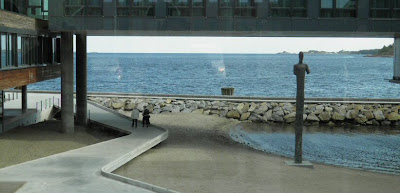
The “Institute of arts, physical education and food” at Vestfold University College, arranged a conference about practical, aesthetic learning (PES: praktisk, estetisk, skapende) in Larvik on May 4-th and 5-th. As a member of the group responsible for preparing the conference, I was eager to experience the keynote presentations and parallel sessions, as well as curious if the conference composition and content would manage to engage the participants. The audience was interdisciplinary and came from Sweden, Denmark and Norway. This group of approximately 150 was a mixture of researchers in arts (music, drama, visual art and dance), teachers in schools and preschools, artists and other people interested in the arts and their value in education. Farris bad (the hotel where the most of participants stayed during the conference) also offered rich variety of embodied, aesthetic experiences.
The program included 3x30-minutes parallel sessions on both of the days. Apart from learning from each other the purpose of the conference was to build network and provide opportunities for people with common interests to meet. See the conference program. Hege Hansson leaded the program (both of us have embodied experience of standing on the main stage between the speakers).

Professor of philosophy Dorthe Jørgensen from University of Aarhus, was the first keynote speaker. Her presentation about “aesthetic thinking” made a brilliant introduction to the conference theme. Two preschool teachers (Veronika Lovise Wist and Anders Skog) presented their prize-winning projects with children, and the projects were commented by Grethe Bekkevold who was a member of the jury who selected the winner for the annual national prize. Tollef Thorsnes’ large three-dimensional installations in wood and flames made the specific ambient in the main conference room.
Professor Liora Bresler, from University of Illinois, was one of the keynote speakers. With her broad knowledge about the global position of the arts (she has for instance edited the “International handbook of research in arts education”, 2007), she spoke about the specific values of the arts and how they can contribute to education.

Hillevi Lenz Taguchi from Stockholm University, spoke about intra-active pedagogy and the importance of physical materials for children’s learning.

Merete Morken Andersen, writer and colleague from Vestfold University College, spoke about the process of creating as both an individual and collective process.

Donatella De Paoli, from Norwegian Business School (BI) approached the arts education from a unique angle addressing relations between arts teaching and society from an economist’s point of view. Turid Amundsen was responsible for practical arrangement long before the conference, and had responsibilities which often appear invisible if everything functions as it should. Geir Salvesen, the dean of the Faculty of Education at the Vestfold University College (and also a music teacher) opened and closed the conference… with hopes for continuing discussions and new possibilities to meet and promote the importance of the arts.

The program included 3x30-minutes parallel sessions on both of the days. Apart from learning from each other the purpose of the conference was to build network and provide opportunities for people with common interests to meet. See the conference program. Hege Hansson leaded the program (both of us have embodied experience of standing on the main stage between the speakers).

Professor of philosophy Dorthe Jørgensen from University of Aarhus, was the first keynote speaker. Her presentation about “aesthetic thinking” made a brilliant introduction to the conference theme. Two preschool teachers (Veronika Lovise Wist and Anders Skog) presented their prize-winning projects with children, and the projects were commented by Grethe Bekkevold who was a member of the jury who selected the winner for the annual national prize. Tollef Thorsnes’ large three-dimensional installations in wood and flames made the specific ambient in the main conference room.
Professor Liora Bresler, from University of Illinois, was one of the keynote speakers. With her broad knowledge about the global position of the arts (she has for instance edited the “International handbook of research in arts education”, 2007), she spoke about the specific values of the arts and how they can contribute to education.

Hillevi Lenz Taguchi from Stockholm University, spoke about intra-active pedagogy and the importance of physical materials for children’s learning.

Merete Morken Andersen, writer and colleague from Vestfold University College, spoke about the process of creating as both an individual and collective process.

Donatella De Paoli, from Norwegian Business School (BI) approached the arts education from a unique angle addressing relations between arts teaching and society from an economist’s point of view. Turid Amundsen was responsible for practical arrangement long before the conference, and had responsibilities which often appear invisible if everything functions as it should. Geir Salvesen, the dean of the Faculty of Education at the Vestfold University College (and also a music teacher) opened and closed the conference… with hopes for continuing discussions and new possibilities to meet and promote the importance of the arts.
fredag 29. april 2011
Expression or Communication?
Some linguists told me that there is no “expression” - the purpose of everything we say is to communicate. I doubt: If I happened to scream when I got scared of something that was absolutely not dangerous, the sound could communicate my surprise and someone could come to see if I was OK. But the screaming sound could have been an immediate reaction (expression of surprising fear) and not a planned action to call for help, and it could be embarrassing if someone had heard it. What I want to say is that the scream was not intended to communicate but was an expression that urged from the inside. Such scream would be a kind of impulsive, intuitive, embodied expression, not planned to influence an addressee in specific way.
We can experience and interpret everything we hear, see, touch or smell – everything can communicate to us even if it was intended to communicate. And the other way around, what we do and how me move might be interpreted by others, however we sometimes do not have other intentions than to experience the sound of own voice or to re-experience a painting or a sculpture we are making. One might say that this also would be a form of communication between a person and the materials that are getting transformed in her/his hands. Such communication would be here-and-now-negotiation between the materials’ qualities and the person’s hand, voice, feelings, ideas…
 A few days ago I observed a six year old girl. A was on the balcony and she did not see. She left her bicycle looking for something (possibly flowers) by the road, and started to sing. None was around – she was singing for herself. Then, she went back to her bicycle to ring the bell, making the music for her song. A year ago I experienced something similar when a video camera captured a five year old boy while he was alone in a room. He was hammering and the rhythm of the hammering sound seemed to remind him of a song he knew and he started to sing for himself: “I was made for loving you baby…”
We sometimes feel inner urge to jump, sing or cry. Young children often do what they feel, but they soon learn to supress our expressions as they socialize. I suppose the both of the children were singing exactly because none could hear them, and not with intention to communicate.
Yet in another occasion I observed a two year old boy; There was a party in the house and many saw that the fell and hit his cheek. Holding his hand over the wounded cheek, and not crying, he asked the people around where his mother was. They pointed and he followed the directions. When he few minutes later finally found his mother, he started to cry. His cry expressed that he was hurt, but it was also a form of communication he wanted to share only with his mother.
I do not have any answers about relations between communicating and expressing – but I keep wondering…

We can experience and interpret everything we hear, see, touch or smell – everything can communicate to us even if it was intended to communicate. And the other way around, what we do and how me move might be interpreted by others, however we sometimes do not have other intentions than to experience the sound of own voice or to re-experience a painting or a sculpture we are making. One might say that this also would be a form of communication between a person and the materials that are getting transformed in her/his hands. Such communication would be here-and-now-negotiation between the materials’ qualities and the person’s hand, voice, feelings, ideas…
 A few days ago I observed a six year old girl. A was on the balcony and she did not see. She left her bicycle looking for something (possibly flowers) by the road, and started to sing. None was around – she was singing for herself. Then, she went back to her bicycle to ring the bell, making the music for her song. A year ago I experienced something similar when a video camera captured a five year old boy while he was alone in a room. He was hammering and the rhythm of the hammering sound seemed to remind him of a song he knew and he started to sing for himself: “I was made for loving you baby…”
We sometimes feel inner urge to jump, sing or cry. Young children often do what they feel, but they soon learn to supress our expressions as they socialize. I suppose the both of the children were singing exactly because none could hear them, and not with intention to communicate.
Yet in another occasion I observed a two year old boy; There was a party in the house and many saw that the fell and hit his cheek. Holding his hand over the wounded cheek, and not crying, he asked the people around where his mother was. They pointed and he followed the directions. When he few minutes later finally found his mother, he started to cry. His cry expressed that he was hurt, but it was also a form of communication he wanted to share only with his mother.
I do not have any answers about relations between communicating and expressing – but I keep wondering…

tirsdag 12. april 2011
Supervisor Worth Gold
I realized it was sunny yesterday. In the last months I’ve been intensively writing the thesis and did not pay attention that the spring has arrived. That’s wonderful: both that the spring is here, and that I can finally lift up my eyes from the screen. I’ve been working hard. Approximately each second week I sent a new chapter to my supervisor Martina Keitsch (see the photo), who read the text in a day and the second day we met to discuss the chapter. Can you imagine how fantastic it has been that she could give me the feed-back so quickly? Imagine if I had to wait for her feed-back for two weeks or a month – the writing process would have to take additional eight months of waiting…
 I can understand that supervisors are busy people with many important tasks – but for a student whose work depends on getting feed-back, it is important that the student is placed close to the top of supervisor’s task list. This is important for the student to get the work done, but, above all, to feel that one’s work is worth something – that one should not give up! When the feed-back is also constructive and encouraging – as Martina’s has been, the supervisor’s support has immeasurable value: she deserves, at least, her own weight in gold :)
I cannot believe I am almost finished with writing the thesis before I send it to a “reader” (which is planned for next week). This is how the last phase of PhD study works at The Oslo School of Architecture and Design: A few months before the thesis is to be delivered, it is sent to an appointed reader, who in about a month gives her/his feed-back. Then it usually takes one to two months to rewrite the thesis. If one needs language editing (as I do since I write in English – my third language) that will probably take another month. And then, there is layout and making sure that references are properly written. This should be easy when one uses the software EndNote – but there are still so many details I would not be able to fix without the help of librarians Heidi K. Olsen and Kristin Østreholt. Thank you thousand times (as we say in Norwegian)!
 I can understand that supervisors are busy people with many important tasks – but for a student whose work depends on getting feed-back, it is important that the student is placed close to the top of supervisor’s task list. This is important for the student to get the work done, but, above all, to feel that one’s work is worth something – that one should not give up! When the feed-back is also constructive and encouraging – as Martina’s has been, the supervisor’s support has immeasurable value: she deserves, at least, her own weight in gold :)
 I cannot believe I am almost finished with writing the thesis before I send it to a “reader” (which is planned for next week). This is how the last phase of PhD study works at The Oslo School of Architecture and Design: A few months before the thesis is to be delivered, it is sent to an appointed reader, who in about a month gives her/his feed-back. Then it usually takes one to two months to rewrite the thesis. If one needs language editing (as I do since I write in English – my third language) that will probably take another month. And then, there is layout and making sure that references are properly written. This should be easy when one uses the software EndNote – but there are still so many details I would not be able to fix without the help of librarians Heidi K. Olsen and Kristin Østreholt. Thank you thousand times (as we say in Norwegian)!
onsdag 6. april 2011
Not strong enough
The last chapter of my thesis is written and I should be happy. However, the last chapters were hard to write, not so much because I was tired, but because I was sad, almost depressed by the results of my study. The new insights are hard to bare and I feel helpless: There are so many layers of misunderstanding and power that prevent children from being seen as competent.
 Young children are promoted as competent in Norwegian “Framework plan for the content and tasks of kindergartens” (Ministry of Education and Research, 2006) and other government documents. However it is not clear what children’s competences are. In my study I have come to conclusion that their competences are in their embodiment – they are experts in sensing, experiencing holistically, taking explorative actions; They are experts learning thought their bodies! Materials in their environment offer them different types of resistance and young children (3 year old) and even the smallest type of resistance (something we adults don’t even notice) can initiate their motivation to solve problems, find solutions, discover how to contribute to others and discover personal knowledge. I have observed the pure moments of knowledge construction - “micro-discoveries”, as I called them. Young children are true experts of imagination which helps them connect their past and present experiences – the essence of creativity and learning!
One can now wonder: This is great news – Why should I be sad about it? The problem is that embodiment is so little acknowledged in today’s educational system. Verbal types of knowledge have much higher status and power that the embodied. What counts is the number of words three year olds can pronounce – and the embodied experience loses the battle. This really does not have to be a battle, but as long as the linguistic forms of knowledge have such a powerful influence of our understanding of quality in education, the embodied forms of knowledge will be supressed. How can we then be able to truly respected for their competences?!
I took responsibility to promote young children’s experiences and woices, and there is not so much I can do. There is so much power against the young children: both because they are young (and age has authority), because they are non-verbal (and verbal has authority), because they are “inherently artful” (Dissanayake, 2007) (and school arts do not have any power), because they are practical (and theoretical has power) … I feel helpless. Can a single PhD-study have any chance in convincing policy making that there is a large need to reconsider what quality of young children’s education is? They should consider the children’s point of view!
 Young children have no political power, they are not strong enough and have no voice of their own. I have promised them to promote their competences, but I fear that I am not strong either. I hope they would forgive me… but by the time they would be able to understand, it will already be too late…
The image of the baby with large weights is from http://drippet.com/wp-content/uploads/2010/04/baby.jpeg
Ministry of Education and Research. (2006). Framework plan for the content and tasks of kindergartens.
 Young children are promoted as competent in Norwegian “Framework plan for the content and tasks of kindergartens” (Ministry of Education and Research, 2006) and other government documents. However it is not clear what children’s competences are. In my study I have come to conclusion that their competences are in their embodiment – they are experts in sensing, experiencing holistically, taking explorative actions; They are experts learning thought their bodies! Materials in their environment offer them different types of resistance and young children (3 year old) and even the smallest type of resistance (something we adults don’t even notice) can initiate their motivation to solve problems, find solutions, discover how to contribute to others and discover personal knowledge. I have observed the pure moments of knowledge construction - “micro-discoveries”, as I called them. Young children are true experts of imagination which helps them connect their past and present experiences – the essence of creativity and learning!
One can now wonder: This is great news – Why should I be sad about it? The problem is that embodiment is so little acknowledged in today’s educational system. Verbal types of knowledge have much higher status and power that the embodied. What counts is the number of words three year olds can pronounce – and the embodied experience loses the battle. This really does not have to be a battle, but as long as the linguistic forms of knowledge have such a powerful influence of our understanding of quality in education, the embodied forms of knowledge will be supressed. How can we then be able to truly respected for their competences?!
I took responsibility to promote young children’s experiences and woices, and there is not so much I can do. There is so much power against the young children: both because they are young (and age has authority), because they are non-verbal (and verbal has authority), because they are “inherently artful” (Dissanayake, 2007) (and school arts do not have any power), because they are practical (and theoretical has power) … I feel helpless. Can a single PhD-study have any chance in convincing policy making that there is a large need to reconsider what quality of young children’s education is? They should consider the children’s point of view!
 Young children have no political power, they are not strong enough and have no voice of their own. I have promised them to promote their competences, but I fear that I am not strong either. I hope they would forgive me… but by the time they would be able to understand, it will already be too late…
The image of the baby with large weights is from http://drippet.com/wp-content/uploads/2010/04/baby.jpeg
Dissanayake, E. (2007). In the beginning: Pleistocene and infant aesthetics and 21st-century education in the arts. In Bresler, L. (Ed.), International Handbook of Research in Arts Education. Dordrecht: Springer.
Ministry of Education and Research. (2006). Framework plan for the content and tasks of kindergartens.
onsdag 16. mars 2011
Targeting at Quintain

During the process of intensive writing of my thesis, I constantly think about guintain. Robert Stake (2006, 2010) taught me that in qualitative research one has to aim at a target which is not too narrow and not to broad – that is what quintain is about. If a researcher aims only to the centre of a target, then he/she probably already knows what is to be found (and might become narrow-sighted); On contrary, if a researcher aims in one direction, without delimiting the phenomenon he/she wants to understand, the study might become too complex and difficult to grasp. Quintain is just the right scope of a target.
 I watch my son training with his bow. It is satisfying to hit the middle of the target, but it is also OK to hit the other colours. I learn from him. But while I am writing the thesis, I constantly have to remind myself what is in the central part and what is in the periphery, or even outside the board that holds the target: Children’s negotiation of meaning with 3D-materials’ affordances and resistance are in the middle of the quintain; Children’s embodied ways of interacting with their environments are also in the middle but stretch outside the centre; And children’s negotiation of meaning with their teachers’ and peers is like a transparent layer that covers the whole scope of my quintain and reaches far outside it. I have to firmly grasp my quintain in order not to get lost…
Stake, R. (2006). Multiple case study analysis. New York: The Guilford Press.
Stake, R. (2010). Qualitative research: studying how things work. New York: The Guilford Press.
søndag 27. februar 2011
Negotiating Grasp
 From Sculpturing Words to Negotiating Grasp – the focus of my study has gradually moved closer to embodied forms of interacting with and knowing our world; I am not saying that linguistic form of knowing is not embodied, but that it is only one of the ways humans acquire understanding of their world and themselves. We all had bodies before we could talk (Egan, 1997).
The new name for my thesis is Negotiating Grasp, with intention to illustrate the importance of physical interaction with materials. I suggest, as Parsons (2007), that thought is embodied.
 Negotiating Grasp is an ambiguous construction where the word negotiating can be understood as both a verb and an adjective. The term I have constructed illustrates the conjunction between, on one side, a child’s physical action of exploring 3D-materials (like a hand grasp), and on the other, the child’s mental grasping of new understandings (through micro-discoveries). The word grasp refers therefore both to a physical and cognitive grasp. When the word negotiating is understood as an adjective, both types of grasp are active processes that a child can negotiate through and between. However, if the word negotiating is understood as a verb, the concept illustrates an activity where, besides a child and 3D-materials also others can be involved in, for example teachers and peers. The concept negotiating grasp is meant to cover all of the mentioned interpretations, with hope to illustrate the complex relation between physical experience, cognition and social influences.
 I have written about children’s play with 3D-materials in the article: Meaning making, democratic participation and art in early childhood education: Can inspiring objects structure dynamic curricula? published in International Journal of Education through Art, 2010 Volume 6 Number 3: http://www.intellectbooks.co.uk/journals/view-issue,id=1945/
Another article has been accepted to be published on http://www.formakademisk.org/index.php/formakademisk
This article is based on the PhD study and is titled: When past and new experiences meet: Negotiating meaning with 3-D materials in early childhood education
Egan, K. (1997). The educated mind: how cognitive tools shape our understanding. Chicago: University of Chicago Press.
Parsons, M. (2007). Art and Metaphor, Body and Mind. In Bresler, L. (Ed.), International Handbook of Research in Arts education (pp. 533-542). Dordrecht: Springer.
tirsdag 8. februar 2011
Tikalalala and other first words
In order to share something verbally, we need to share understanding of what words refer to. When children learn words, they first have to realize that a specific composition of sounds can represent something that can be experienced, and then they need to connect these two together.
 Sometimes a child invents more complex connection – like when my little neighbour pointed at me and said “wuff-wuff” when I was passing his window the other day, and he couldn’t even see my dog. What he probably meant was: There is the woman who always walks with a dog. And he was right – he had probably never seen me without the dog!
Many years ago, when my son was eight months old, he was looking at my face intensively and then smashed his open hand into my cheek simultaneously saying “mama”. And I knew he had just discovered the connection…
 The word “mama”, consisting of two easy-pronounced sounds seems to be quite similar in many languages, while some other words are pretty unique and have short lifetime. Tikalalala is one such word, invented by a little boy and known only to him. It was probably functional to some extent, but when the boy couldn’t find his Tikalalala, cried and cried, whole family was engaged in searching for the Tikalalala. I was myself one of the cousins that happened to be in the house. The search was not an easy task, because no one except for the boy knew what Tikalalala was, and he was young (I guess about three) and not able to explain.
 Children sometimes invent words they need for some specific purpose or in order to express their experiences. In the case of Tikalalala, the word’s rhythmical repetition of sounds might actually remind of the rhythmical movement of the object it refers to, and the sound it makes – while it’s original word does not have. However, the “proper word” was difficult to pronounce in this specific language “kljucevi”; No wonder the boy had to invent a unique word that also could connect him to his dear experiences with cars and car driving.
 Sometimes a child invents more complex connection – like when my little neighbour pointed at me and said “wuff-wuff” when I was passing his window the other day, and he couldn’t even see my dog. What he probably meant was: There is the woman who always walks with a dog. And he was right – he had probably never seen me without the dog!
Many years ago, when my son was eight months old, he was looking at my face intensively and then smashed his open hand into my cheek simultaneously saying “mama”. And I knew he had just discovered the connection…
 The word “mama”, consisting of two easy-pronounced sounds seems to be quite similar in many languages, while some other words are pretty unique and have short lifetime. Tikalalala is one such word, invented by a little boy and known only to him. It was probably functional to some extent, but when the boy couldn’t find his Tikalalala, cried and cried, whole family was engaged in searching for the Tikalalala. I was myself one of the cousins that happened to be in the house. The search was not an easy task, because no one except for the boy knew what Tikalalala was, and he was young (I guess about three) and not able to explain.
 Children sometimes invent words they need for some specific purpose or in order to express their experiences. In the case of Tikalalala, the word’s rhythmical repetition of sounds might actually remind of the rhythmical movement of the object it refers to, and the sound it makes – while it’s original word does not have. However, the “proper word” was difficult to pronounce in this specific language “kljucevi”; No wonder the boy had to invent a unique word that also could connect him to his dear experiences with cars and car driving.
lørdag 29. januar 2011
Caballo
Our mobile bodies move through the world collecting experiences from numberless variation of unique contexts. In the beginning, before we have had time to collect so many, maybe we have only four from meeting different cats, and many experiences from meeting the same horse. Here is how a six year old girl presents a horse – probably the Fjording she knows from her farm-preschool (Fjordings are strong and a bit round, and wear their mane strait up).
 But what can one do when he desires to share an experience, but cannot draw nor have the right words to tell?
If a child’s learning of verbal language springs from her or his own experience – weather the experience is actual or imaginative, as Dewey suggested (Flanagan, 2006), then each of us have personal understanding of concepts – words are loaded with our feelings from the specific contexts where the concept was first conceived (Høigård, 2006). Here is how a two year old Spanish boy was constructing a new concept:
His “word” for a horse was not a set of sounds, but rather a short story that described his experience from meeting with a horse: He stretched his arm with open palm and said “pan, pan”. Then he made a “prprprprprpr…” sound by blowing between his lips, and simultaneously and quickly shaked his head.
 To be able to understand his concept-under-construction one has to know that “pan” means bread, and to be able to imagine a little hand holding a piece of bread while bravely trying to stretch his tiny arm in order to keep his body as far as possible from the large horse mouth. The boy’s story described how he feed the horse and the sound and the head-shaking described what the horse did.
What a creative construction he initiated all by himself! And while he was telling people about the horse they often responded: “Sí! Caballo!” That is probably how he will learn to compress his embodied experiences in a few letters…
Flanagan, F. M. (2006). The greatest educators ever. London: Continuum.
Høigård, A. (2006). Barns språkutvikling: muntlig og skriftlig. Oslo: Universitetsforl.
 But what can one do when he desires to share an experience, but cannot draw nor have the right words to tell?
If a child’s learning of verbal language springs from her or his own experience – weather the experience is actual or imaginative, as Dewey suggested (Flanagan, 2006), then each of us have personal understanding of concepts – words are loaded with our feelings from the specific contexts where the concept was first conceived (Høigård, 2006). Here is how a two year old Spanish boy was constructing a new concept:
His “word” for a horse was not a set of sounds, but rather a short story that described his experience from meeting with a horse: He stretched his arm with open palm and said “pan, pan”. Then he made a “prprprprprpr…” sound by blowing between his lips, and simultaneously and quickly shaked his head.
 To be able to understand his concept-under-construction one has to know that “pan” means bread, and to be able to imagine a little hand holding a piece of bread while bravely trying to stretch his tiny arm in order to keep his body as far as possible from the large horse mouth. The boy’s story described how he feed the horse and the sound and the head-shaking described what the horse did.
What a creative construction he initiated all by himself! And while he was telling people about the horse they often responded: “Sí! Caballo!” That is probably how he will learn to compress his embodied experiences in a few letters…
Flanagan, F. M. (2006). The greatest educators ever. London: Continuum.
Høigård, A. (2006). Barns språkutvikling: muntlig og skriftlig. Oslo: Universitetsforl.
mandag 17. januar 2011
Just busy with writing…
I haven't forgotten about this blog, but will have less time to publish on it this spring. This is (hopefully) the last spring of my PhD study, and I will from August 1-st be back on my job at the Vestfold University College. That means that I have to finish writing my thesis already in April, in order to send it to a reader, have time to re-write, edit and polish the language and have it delivered by the end of the summer.
 The intensive writing started a few weeks ago in a little village in Northern Spain – in the peaceful surroundings I managed to produce almost one chapter a week (of course not form the scratch). And my friend Nicola was there, always ready to discuss my writing, help with the English and invite to walk, or a riding trip with her horses.
I am very happy with my new advisor Dr. Martina Keitsch – I’ve just sent her my second chapter, and the third should be on its way in a couple of weeks. I am also glad for the feed-backs I’ve received on my two articles (one sent to FORMakademisk, the other to A-Techne) … it is just that they need some revision and that also takes time… So, don’t worry if I don’t write on this blog as often as I should … I am probably writing something else…
 Here are some pictures from my office, second floor over the garage. (The sawing machine is close, but not so much in use lately :( My dog Zorro sometimes keeps me company, and plays with empty water bottles.
 The intensive writing started a few weeks ago in a little village in Northern Spain – in the peaceful surroundings I managed to produce almost one chapter a week (of course not form the scratch). And my friend Nicola was there, always ready to discuss my writing, help with the English and invite to walk, or a riding trip with her horses.
I am very happy with my new advisor Dr. Martina Keitsch – I’ve just sent her my second chapter, and the third should be on its way in a couple of weeks. I am also glad for the feed-backs I’ve received on my two articles (one sent to FORMakademisk, the other to A-Techne) … it is just that they need some revision and that also takes time… So, don’t worry if I don’t write on this blog as often as I should … I am probably writing something else…
 Here are some pictures from my office, second floor over the garage. (The sawing machine is close, but not so much in use lately :( My dog Zorro sometimes keeps me company, and plays with empty water bottles.
Abonner på:
Innlegg (Atom)