Viser innlegg med etiketten craft. Vis alle innlegg
Viser innlegg med etiketten craft. Vis alle innlegg
fredag 10. juni 2016
Learning to Learn
I recently wrote an article about learning through first-hand-experience. The paper is to be presented at Design + Research + Society DRS2016 conference in Brighton in the end of June. It is available for reading here: http://www.drs2016.org/103
 Here is the abstract: A child cannot be taught how to walk – it has to sense the balance of its body, the smoothness of the floor, the strength of its muscles, and respond appropriately. The author argues that the process of learning depends on embodied functions and subjective experiences of the one who is learning. This paper discusses the first-hand perspective in the process of material transformation. During such a process, the acting person has to be attentive and make innumerable adaptive choices. Examples from a doctoral study focusing on young children (3 year olds), illustrate how the children’s first-person experiences related to their learning. The author proposes that similar processes take place at all ages and that experience of learning through material transformation is an arena for learning how to learn. The paper initiates discussion about interactive relationships between the senses, attention, emotional engagement, responsibility, mastery, self-confidence and learning during material transformations.

lørdag 20. februar 2016
What could a Serbian donkey teach Norwegian students?

Students of teacher education at University College of Southeast Norway were exposed to an extraordinary challenge when they were asked to help a donkey with her health troubles. Maza-donkey had traveled far away from home in Serbia, over seven mountains and seven seas, to a place in Norway where grass was greener… dangerously greener. The change of climate and food did not do her well, she got laminitis (horse disease caused by too much sugar and proteins in food) and she desperately needed help to keep her dissolving hooves dry during the long Norwegian winter.

The fall after Maza got sick I was responsible for visual art teaching in a wonderful group of 17 students of teacher education. Their excitement inspired me to come up with an idea that they could design a shelter for Maza. That would be a realistic problem for them to solve – with pedagogical capacity to engage them, make them learn though experience and get inspired how they could plan their future teaching of school children.

A large cage-like construction was occasionally standing just outside the art department. It was a rest from reconstruction of the building. It needed to be removed anyway, and we saw possibilities how to transform it into a castle for Maza - who we imagined was a donkey princess. The students designed square applications in water-proof textile to fill the windows in the metal frame. Maza herself inspired the designs: some of the motives were her hairy ears, happy tail and mystical cross on her back. The students that were inspired by a story about “princess Maza” gave her diamonds and other things a princess should have in her castle. Some students made landscapes to remind her of her beloved home county. One student even made an applique of Serbian national fruit plum, unaware of the fact that Maza once upon the time actually lived in a plum garden…

Maza taught the students about empathy and designing for specific purpose and needs. She taught them about the importance of imagination in learning and teaching, and how meaningfulness comes from feeling of being of value for someone else… event if (or exactly because?) that someone else is a little helpless donkey. There is so much mastery and joy in the experience that out efforts matter to someone.

Thanks to Henning, Terje and Thomas who helped with transporting of the “cage-construction” from University College of Southeast Norway to the stables at Holt, Stokke, and to Marianne and Roger that allowed us to place it on their property.

This story has also been edited and published at the
web-page of Norwegian embassy in Serbia: http://www.norveska.org.rs/News_and_events/News-and-events1/What-could-a-Serbian-donkey-teach-Norwegian-students/#.Vsi3RWf2bIU
søndag 10. januar 2016
A hen without head and a dragon
While I am filming my three years old niece play with playdough, she is explaining what she is doing. She presses small pieces of the material together and says that it is important to make them stick. Then she cuts playdough with a knife in many small pieces. I ask her what she is going to do with so many pieces. She says that this is the right way to do it – and her voice is very convincing.
 At one point, she starts laughing and pointing at the lump in front of her: "Look!"
I do not understand what she is trying to show me.

She tries again: "See? The hen does not have a head!", she laughs. She is right, I can not see any head. I can not see a hen, either! - but I laugh together with her. Along with our playful laughter, I sense how she is becoming even more confident in his actions. She now turns the invisible hen around and announces with surprise in her voice: "Oh! Now it became a dragon!" The tail of the chicken without a head, became a head for a dragon. She starts taking pieces of playdough, pressing them between her thumbs and forefingers and making flat chips to shape a kind of armor for the dragon. I wonder what thas is, and she says that the dragon needs protection from rain.

I am curious about her ideas and I ask her where she had seen such a dragon: “Have you may be seen it in books, on TV, or somewhere else?”
She responds: “No! I have not seen it anywhere. I made it!”
I try again to identify the source of her inspiration: "Perhaps such dragons exist in fairy tales?"
But she is determined: "No, no! It does not exist anywhere else, but here!!!”
She is the proud creator of the unique dragon that was born from a hen with no tail – and she knows it! I could almost hear and smell her increasing self-confidence.

I do not understand what she is trying to show me.

She tries again: "See? The hen does not have a head!", she laughs. She is right, I can not see any head. I can not see a hen, either! - but I laugh together with her. Along with our playful laughter, I sense how she is becoming even more confident in his actions. She now turns the invisible hen around and announces with surprise in her voice: "Oh! Now it became a dragon!" The tail of the chicken without a head, became a head for a dragon. She starts taking pieces of playdough, pressing them between her thumbs and forefingers and making flat chips to shape a kind of armor for the dragon. I wonder what thas is, and she says that the dragon needs protection from rain.

I am curious about her ideas and I ask her where she had seen such a dragon: “Have you may be seen it in books, on TV, or somewhere else?”
She responds: “No! I have not seen it anywhere. I made it!”
I try again to identify the source of her inspiration: "Perhaps such dragons exist in fairy tales?"
But she is determined: "No, no! It does not exist anywhere else, but here!!!”
She is the proud creator of the unique dragon that was born from a hen with no tail – and she knows it! I could almost hear and smell her increasing self-confidence.
lørdag 27. juni 2015
Waiting for a Yellow Dress
“Why didn’t you come earlier?! I have been waiting for you so
long! I have been waiting for a million time!” Ana was three and a half years
old and had learned that “million” was really much. “Hundred of million time!!!” she added while she was tramping
with her foot and stretching her arms and fingers toward me. She was acting
angry. When she saw me at the door, she first gave me a big hug and a broad
smile, and then she remember that she was supposed to be angry. Yes, I was guilty: my flight company was on
strike and I was 7 hours delayed. She had been waiting for me the whole day,
and now she had to go to sleep. We had not seen each other for eight months and
that is really long time for an aunt and a niece.


The next morning we went to a close by textile shop, not exactly a dress-textile shop, but they had some nice curtain fabrics. Ana found something she liked, not exactly yellow textile, but light violet, just thick enough for a spring dress that would swing well. We also found some nice ribbons, buttons and other accessories in matching colors and we were ready for action. First we made a drawing, measured length and width. Ana helped with measuring and cutting, as well as with feeding the sewing machine. She was patiently participating in the whole process of the creative dressmaking. Her patience was challenged additionally when the sawing machine went on strike (too) and we could not finish the dress the same day. The morning after, I took the dress and went to visit Ana at her pre-school. “I knew you would come!” she shouted when I arrived, and she wanted to try the dress on immediately. It fitted perfectly! The following days Ana carried the dress - sometimes on, sometimes in her backpack, but always with her.

søndag 31. august 2014
Viking Inspired Clothes Design
I spent much
of this summer on sawing. I do not complain: I am indeed happy that I accepted
the invitation from Ethonopeia to take a part on an international fashion show on
Zlatibor in Serbia. I’ve been designing clothes and sawing them much of my
life, but seldom took time to create something which is truly my own design, without
considering a costumer’s wishes. This was a wonderful experience.

Me in the middle
tirsdag 10. april 2012
Tree Huts and Bending Nails
One of outdoor activities that my international students have been dealing with this spring was building of tree huts. The activity was a part of subject “art and crafts” with extended focus on experiential learning (the name of the course is Outdoor education and experiential learning); The main “products” of the project were not the huts themselves, but the students’ collaborative processes including all kinds of experiences that could possibly emerge: experiences with nature, tools, creative ideas, group discussions, design challenges, materials’ qualities … as well as luck of appropriate tools, materials or trees with desirable branches.
 Three groups, with seven students each, had seven days to build three huts with a selection of recycled planks. Each groups had hand tools, like hammers and saws, rope for assembling with living trees and nails for assembling dead wood. The trees were not to be hurt by nails, but there was still much work to be done with hammers, which seemed to be unfamiliar tool for some of the students. It’s not that the students had never used hemmers before, but when the hut building demanded improved speed and quality of nailing, and the nails kept banding, the activity became a group challenge - actually a challenge each of the groups reported later. In their presentation of the building process the students recalled how they tried to understand why the nails banded: Was the metal too soft or the wood too hard? Was something wrong with the hammer? Was it about how long one held the nail before releasing it? They discussed the angle of hammer and way of hitting the nails’ head. They made suggestions and tested new ways of solving this apparently simple problem. But the long, annoying nails kept banding – at least for two of groups. The third group reported no problems with the long nails, however they found the short nails to be impossible. This made the nail mystery even more mysterious…
 Activity of nailing involves wood, nails, hammer, hand and whole body that have to negotiate one with another. The easiest excuse for not succeeding in nailing would be to blame the quality of nails, hammers or even the wood, but this would not help you improve. It is only through facing the challenge that you can learn something and achieve mastery. Nails can band for many reasons, but if you are determined to continue, you can try noticing and reflecting about what you do with your body: there are many possible ways of grasping a hammer, using muscles, head positioning, directing eyes, banding back, supporting a nail… You will be surprise how much embodied knowledge is demanded from such a simple activity; You will be amazed by how much knowledge is already stored in your body.
 Apart from the nail-problem the groups reported many other challenges that provided them with fresh experiences. Hundreds of practical and aesthetic choices had to be negotiated between the participants and each of them had something unique to contribute with. The fact they were exposed to heavy materials, heights and risky tools, made them develop collective responsibility for each other’s safety. Knowing that the project depended on each of them seemed to make them motivated, proud and emotionally attached, and to make their experiences meaningful and memorable.
 Three groups, with seven students each, had seven days to build three huts with a selection of recycled planks. Each groups had hand tools, like hammers and saws, rope for assembling with living trees and nails for assembling dead wood. The trees were not to be hurt by nails, but there was still much work to be done with hammers, which seemed to be unfamiliar tool for some of the students. It’s not that the students had never used hemmers before, but when the hut building demanded improved speed and quality of nailing, and the nails kept banding, the activity became a group challenge - actually a challenge each of the groups reported later. In their presentation of the building process the students recalled how they tried to understand why the nails banded: Was the metal too soft or the wood too hard? Was something wrong with the hammer? Was it about how long one held the nail before releasing it? They discussed the angle of hammer and way of hitting the nails’ head. They made suggestions and tested new ways of solving this apparently simple problem. But the long, annoying nails kept banding – at least for two of groups. The third group reported no problems with the long nails, however they found the short nails to be impossible. This made the nail mystery even more mysterious…
 Activity of nailing involves wood, nails, hammer, hand and whole body that have to negotiate one with another. The easiest excuse for not succeeding in nailing would be to blame the quality of nails, hammers or even the wood, but this would not help you improve. It is only through facing the challenge that you can learn something and achieve mastery. Nails can band for many reasons, but if you are determined to continue, you can try noticing and reflecting about what you do with your body: there are many possible ways of grasping a hammer, using muscles, head positioning, directing eyes, banding back, supporting a nail… You will be surprise how much embodied knowledge is demanded from such a simple activity; You will be amazed by how much knowledge is already stored in your body.
 Apart from the nail-problem the groups reported many other challenges that provided them with fresh experiences. Hundreds of practical and aesthetic choices had to be negotiated between the participants and each of them had something unique to contribute with. The fact they were exposed to heavy materials, heights and risky tools, made them develop collective responsibility for each other’s safety. Knowing that the project depended on each of them seemed to make them motivated, proud and emotionally attached, and to make their experiences meaningful and memorable.
søndag 19. februar 2012
Desire for Ski Design
With a group of students who are taking a course of “Outdoor education and experiential education” (the course Vestfold University College offers in English each spring) I visited Norwegian ski museum in Morgedal in Telemark. My colleague who teaches physical education has been there before and also this time she arranged a presentation by a museum pedagogue. I had not been there before and did not know what to expect; I ended amazed by what I happened to experience.
 The museum itself was interesting enough, but the museum pedagogue with her engagement and ability to connect with the group, helped us to imagine and connect with people from the past. One of such people was Sondre Norheim who considerably improved design of skis about 150 years ago.
Sondre’s family lived purely in a little cottage and did not own any land. They had to work hard in order to survive, and working and moving outdoors was not easy in winter time considering the large amounts of snow in the mountains of Telemark. Sondre wanted to move faster not only in order to fulfill his duties, but also to have fun beyond everyday occupations. He dreamt of speed, ski jumps, and easy maneuvers; He desired to draw curves in the snow while dancing across dunes. But skis of that time could not give him these pleasures.
In order to achieved what he wished for, Sondre had to redesign the skis, make them shorter, lighter, improve the lines and the way skis were attached to the foot. And in order to accomplish that, he had to understand how design qualities of these seemingly simple objects relate to different types of movements achieved through negotiations between human body, gravity and landscape; He had to understand snow and possibilities of own body, as well as to truly understand diverse qualities of wood. I assume that such kinds of understanding were not acquired by reading books, but through physical experience – “learning by doing”. Diverse qualities of natural materials (snow, wood, landscape and human body) gave him all kinds of resistances he needed in order to learn.
Referring to Dewey’s (1925) notion of “body-mind” and his intention to justify the importance of natural materials for learning (Dewey, 1956), as well as refereeing to my own experience with children and materials, I suggest:
“Natural materials offer diverse sensory experiences, multiple possibilities for exploration and transformation, motivation, ecological consciousness, and above all resistance. Through body-mind negotiation with natural materials a child [or an adult] can meet unexpected problems and experience what it is like to create unpredicted solutions” (Fredriksen, 2011 p.128).
In order to succeed, Sondre had to be engaged in negotiations between his hands, tools and wood and continuously remain aesthetically attentive to the material’s affordances and constrains. His motivation derived from his desires to dance in accordance with landscapes. However in order to succeed he also needed persistence in order to meet the challenges of not yet discovered design possibilities. Additionally, courage was needed in order to hold on his dreams even when people around thought he was crazy.
References:
Dewey, J. (1925) Experience and nature. Chicago: Open Court.
Dewey, J. (1956) The child and the curriculum. In J. Dewey (Ed.), The child and the curriculum & The school and society (pp. 31). Chicago: University of Chicago Press.
Fredriksen, B. C. (2011). Negotiating grasp: Embodied experience with three-dimensional materials and the negotiation of meaning in early childhood education. 50, The Oslo School of Architecture and Design, Oslo. (http://brage.bibsys.no/aho/handle/URN:NBN:no-bibsys_brage_25972 )
 The museum itself was interesting enough, but the museum pedagogue with her engagement and ability to connect with the group, helped us to imagine and connect with people from the past. One of such people was Sondre Norheim who considerably improved design of skis about 150 years ago.
Sondre’s family lived purely in a little cottage and did not own any land. They had to work hard in order to survive, and working and moving outdoors was not easy in winter time considering the large amounts of snow in the mountains of Telemark. Sondre wanted to move faster not only in order to fulfill his duties, but also to have fun beyond everyday occupations. He dreamt of speed, ski jumps, and easy maneuvers; He desired to draw curves in the snow while dancing across dunes. But skis of that time could not give him these pleasures.
In order to achieved what he wished for, Sondre had to redesign the skis, make them shorter, lighter, improve the lines and the way skis were attached to the foot. And in order to accomplish that, he had to understand how design qualities of these seemingly simple objects relate to different types of movements achieved through negotiations between human body, gravity and landscape; He had to understand snow and possibilities of own body, as well as to truly understand diverse qualities of wood. I assume that such kinds of understanding were not acquired by reading books, but through physical experience – “learning by doing”. Diverse qualities of natural materials (snow, wood, landscape and human body) gave him all kinds of resistances he needed in order to learn.
Referring to Dewey’s (1925) notion of “body-mind” and his intention to justify the importance of natural materials for learning (Dewey, 1956), as well as refereeing to my own experience with children and materials, I suggest:
“Natural materials offer diverse sensory experiences, multiple possibilities for exploration and transformation, motivation, ecological consciousness, and above all resistance. Through body-mind negotiation with natural materials a child [or an adult] can meet unexpected problems and experience what it is like to create unpredicted solutions” (Fredriksen, 2011 p.128).
In order to succeed, Sondre had to be engaged in negotiations between his hands, tools and wood and continuously remain aesthetically attentive to the material’s affordances and constrains. His motivation derived from his desires to dance in accordance with landscapes. However in order to succeed he also needed persistence in order to meet the challenges of not yet discovered design possibilities. Additionally, courage was needed in order to hold on his dreams even when people around thought he was crazy.
References:
Dewey, J. (1925) Experience and nature. Chicago: Open Court.
Dewey, J. (1956) The child and the curriculum. In J. Dewey (Ed.), The child and the curriculum & The school and society (pp. 31). Chicago: University of Chicago Press.
Fredriksen, B. C. (2011). Negotiating grasp: Embodied experience with three-dimensional materials and the negotiation of meaning in early childhood education. 50, The Oslo School of Architecture and Design, Oslo. (http://brage.bibsys.no/aho/handle/URN:NBN:no-bibsys_brage_25972 )
søndag 28. august 2011
Attuning Tools, Materials and Muscles
An incredible project of reconstructing a Viking ship is taking place in Tønsberg at the moment (see http://www.osebergvikingskip.no/eng/) and is expected to take another autumn, winter and spring. The original ship called Oseberg, made by Vikings around the year 820, and later berried in Tønsberg area, is today exhibited at the Viking museum in Oslo.
 The same ship has been reconstructed before, but this time not only the ship is being copied, but the entire process of building it. The building process is shaped by knowledge about Vikings’ tools and techniques; knowledge about wood’s diverse qualities, as well as how it might have been affected by climate during the centuries of growing; knowledge about the ship’s lines, curves, joints, surface; hydrodynamic, waterproof and other qualities, and much more. In short, the reconstruction of the full size replica is a huge multidisciplinary project that calls on complex combinations of knowledge and expertise. Additionally, local knowledge is constantly being produces in here-and-now situations where physical work challenges craft-men and volunteers to master the tools and approach the materials (wood, iron or wool) in contextually appropriate manners. This means that they have to pay close attention to the exact qualities of the wood piece they have in hand, they have to adjust their movements according to the material, tool and muscles in their bodies… and to accomplish some kind of harmony between embodied knowledge, reflection and imagination in order to solve emerging problems - for instance: how to change axe’s angles when cutting across a 70 cm thick oak.
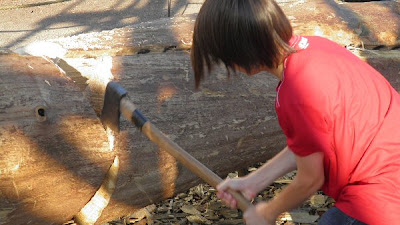 I am telling this from my personal experience. Usually I use saw to cut wood, but Vikings did not have saws. Cutting wood "the Viking-way" seemed easy when we were shown how to do it; doing it oneself was a quite different experience – I am sure it was also different experience for each of us (my three 13 years old companions and me) who volunteered that day.
I experienced how important it was to keep changing the angle of the blade in order to make a “V”-like shape (or rather “U”-shape, as learned through experience) through the wood; I experienced how loose I should hold around the handle in order to prevent hurting my wrists; which back muscles to engage; in which position to drop the axe; how to slide my hands along the handle in order to control to blade’s direction; how to find the right rhythm to provide the best efficiency, and so on… Each of the boys seemed to explore their own cutting technique, for instance banding and straitening knees in order to canalise power from feet up to the axe’s blade. They generally gave the most they had, claiming that they were not tired, but the following days, I’ve heard, the experience left some noticeable traces in their bodies – nothing permanent, but something to help them remember.
If cutting with an axe was our daily occupation, as it was for many Vikings, we would have to listen to our bodies much better – we would have to learn how to attune the bodies, tools and materials as perfectly as possibly. We would have to learn much, much more…
 The same ship has been reconstructed before, but this time not only the ship is being copied, but the entire process of building it. The building process is shaped by knowledge about Vikings’ tools and techniques; knowledge about wood’s diverse qualities, as well as how it might have been affected by climate during the centuries of growing; knowledge about the ship’s lines, curves, joints, surface; hydrodynamic, waterproof and other qualities, and much more. In short, the reconstruction of the full size replica is a huge multidisciplinary project that calls on complex combinations of knowledge and expertise. Additionally, local knowledge is constantly being produces in here-and-now situations where physical work challenges craft-men and volunteers to master the tools and approach the materials (wood, iron or wool) in contextually appropriate manners. This means that they have to pay close attention to the exact qualities of the wood piece they have in hand, they have to adjust their movements according to the material, tool and muscles in their bodies… and to accomplish some kind of harmony between embodied knowledge, reflection and imagination in order to solve emerging problems - for instance: how to change axe’s angles when cutting across a 70 cm thick oak.
 I am telling this from my personal experience. Usually I use saw to cut wood, but Vikings did not have saws. Cutting wood "the Viking-way" seemed easy when we were shown how to do it; doing it oneself was a quite different experience – I am sure it was also different experience for each of us (my three 13 years old companions and me) who volunteered that day.
I experienced how important it was to keep changing the angle of the blade in order to make a “V”-like shape (or rather “U”-shape, as learned through experience) through the wood; I experienced how loose I should hold around the handle in order to prevent hurting my wrists; which back muscles to engage; in which position to drop the axe; how to slide my hands along the handle in order to control to blade’s direction; how to find the right rhythm to provide the best efficiency, and so on… Each of the boys seemed to explore their own cutting technique, for instance banding and straitening knees in order to canalise power from feet up to the axe’s blade. They generally gave the most they had, claiming that they were not tired, but the following days, I’ve heard, the experience left some noticeable traces in their bodies – nothing permanent, but something to help them remember.
If cutting with an axe was our daily occupation, as it was for many Vikings, we would have to listen to our bodies much better – we would have to learn how to attune the bodies, tools and materials as perfectly as possibly. We would have to learn much, much more…
fredag 19. august 2011
Objects' Affordances
 With wide number of qualities, objects around us afford us with different possibilities. Some objects are designed to function in specific ways (like chairs or cars), while natural objects and materials do not have any pre-assigned meanings – it is up to each of us to interpret possibilities embedded in their forms.
 Qualities of an object can remind us of something else, thus, as well-behaving adults we would seldom wear a bucket. To be able to see possibilities in objects that already have preserved pre-assigned functions one needs to release imagination – and have self-confidence.
 Some objects, textures or shapes remind us of something we’ve earlier experienced. See for instance how 13-year old William found similarities between a round shape of a branch and a glass: He grasped the possibility in the material, imagined its possible function and carved a glass-holder. See also how he used old pants to make back-support on the chair he designed and crafted by himself.
tirsdag 19. oktober 2010
Experiencing Environments
How does your home environment influence you feelings? Do you care if the floor is wooden - or just looks like wood? Or do you prefer polished, shiny surfaces? (Guggenheim museum in Bilbao)

Once upon a time, no other than natural materials were available; People used what their surroundings afforded them with: they ate meet they could catch, made clothes of fur and straw, built shelters of mud, or snow.

My friends fell in love with a 200 years old house in a little village in Northern Spain. (They did not tell me exactly that they “fell in live”, but I guess they did – Where would they otherwise find so much motivation and energy for the reconstruction that has been going on for years?) As far as possible they’ve been using the same natural materials the house was built with: mostly stone and wood, not to forget the roof tiles made by hand and shaped over a thigh. The old wooden posts and the rock walls, full of calcium and fossils, witness the time without machines. Shaped by bare hands and simple tools, the surfaces and lines in the house echo shapes from nature. The absence of geometry gives a special feeling … like going back in time … (Experience it by yourself! http://manzanela.com/en/manzanela.php )
 Back in time people used what was available – today we use what we can afford. Compared to the speed of tree’s growing, artificial materials are produced much faster – no wonder natural materials are more expensive! But what is best for the global environment: to use (probably also misuse) the natural resources, or to produce unnatural materials (and waist)? Are we saving trees by using unnatural materials, or is the damage we make much larger? Which thoughts will they make about our time when they in 1000 years discover rests of linoleum with wood imitations?
 The last three images are from the new building of Vestfold University College, where natural and human-made materials are "composed" in thrilling contrasts.

Once upon a time, no other than natural materials were available; People used what their surroundings afforded them with: they ate meet they could catch, made clothes of fur and straw, built shelters of mud, or snow.

My friends fell in love with a 200 years old house in a little village in Northern Spain. (They did not tell me exactly that they “fell in live”, but I guess they did – Where would they otherwise find so much motivation and energy for the reconstruction that has been going on for years?) As far as possible they’ve been using the same natural materials the house was built with: mostly stone and wood, not to forget the roof tiles made by hand and shaped over a thigh. The old wooden posts and the rock walls, full of calcium and fossils, witness the time without machines. Shaped by bare hands and simple tools, the surfaces and lines in the house echo shapes from nature. The absence of geometry gives a special feeling … like going back in time … (Experience it by yourself! http://manzanela.com/en/manzanela.php )
 Back in time people used what was available – today we use what we can afford. Compared to the speed of tree’s growing, artificial materials are produced much faster – no wonder natural materials are more expensive! But what is best for the global environment: to use (probably also misuse) the natural resources, or to produce unnatural materials (and waist)? Are we saving trees by using unnatural materials, or is the damage we make much larger? Which thoughts will they make about our time when they in 1000 years discover rests of linoleum with wood imitations?
 The last three images are from the new building of Vestfold University College, where natural and human-made materials are "composed" in thrilling contrasts.
 tirsdag 14. september 2010
Without experience – How would you know?
 I told my son (12) that he should not bite his nails, and he replayed: “But if I did not bite them, how would I know that the thumb nail is the thickest, hardiest and tears differently than the other nails?”
He was right: How would he know without experience?
We tend to understand thought as something opposite to what is directly perceived (Dewey, 2009). Michael Parsons suggests that thought itself is embodied (Parsons, 2007). I do not doubt that experience is essential for our understanding of the world and ourselves … it is just so seldom that we use words to mediate, explain, share, reflect about our embodied experiences.
 Marte Gulliksen connects her experiences, thoughts and feelings in poetic descriptions of her embodied interactions with a three-dimensional material. In her master thesis – conducted as “research by design”- she wrote about her experience acquired through interactions with piece of wood she was carving. She observes her hands, tools and materials both from the inside of her body, and form the outside: with her eyes, nose, ears. And she tells us (and herself) about her intimate meeting with the material being shaped:
”The wood needs a long period of intense persuasion to accept my ideas, but when the shapes are found at last, the knife follows the fibres as if they had a secret agreement as to where they were heading. The knife follows the directions of the fibres. When they meet, the fibres and the knife, they unite like rivers connect, meet gliding down through shallow valleys” (Gulliksen, 2001)
Can writing about our experience help us to understand better? And what can we achieve by reflecting about the connections between thought, feelings and an experience? I believe more that we can imagine! But as far as our “tacit knowledge” and embodied experience remain unspoken, I fear they will remain a non-issue in discussions about learning.
 I don’t have an image of Marte’s wood-work. The images presented here show two small sculptures that have been through hands of two male artists: “The Heart” has been cut on the lathe, re-constructed and polished by Tollef Thorsnes. Another piece of wood has many times been turned around in Mikael Nilsson’s palms; The shape of a horse that was hidden inside, slowly made itself recognizable through the artist’s touch (more than through his sight) and motivated his further actions with the knife. (I can tell this because I observed Mikael while he was making other small sculptures at the Slöjd conference in Linköping, in August 2010.)
Dewey, J. (2009). How We Think. Available from Digireads.com
Gulliksen, M. (2001). The Creative Meeting - A discussion over the Aesthetic Elements in the Creative Process. In C. Nygren-Landgärds & J. Peltonen (Eds.), Visioner om slöjd och slöjdpedagogik: visions on sloyd and sloyd education (pp. 55-64). Vasa: NordFo.
Parsons, M. (2007). Art and Metaphor, Body and Mind. In L. Bresler (Ed.), International Handbook of Research in Arts education (pp. 533-542). Dordrecht Springer.
mandag 30. august 2010
Experiencing tools
A few weeks ago, at the slöjd (handcraft) conference in Sweden, I heard of a research project about how young students learn to cat “strait” with a saw. If you don’t think cutting a piece of wood is knowledge, just try to imagine a child finding out how to hold a saw for the first time, how hard to push and press, how to adjust the rhythm of movements to the own breathing, length of the arms and sprawling elbows. The task is actually quite complicated if we take in consideration that different types of wood, with different levels of moisture and structure, would respond differently, and that also the tools’ qualities would demand variations in strength, time, precision, patience... Yes, it seems easy to use a saw when you have done it before. When you know how to do it, the knowledge suddenly seems to be hidden, your earlier struggles forgotten, and the complexity of the task somehow becomes invisible… the knowledge becomes tacit…
 My little friend, 2,5 years old, was taking part in constructing garden furniture from ready-made parts, no sawing was involved. Still there was much to learn. First we found out which parts should be screwed together, and then the construction was mostly about screwing the parts together with a little tool. Before I knew about it, he had observed the activity of my hands. I was holding the tool between my forefinger and the middle finger while I was twisting it around. He did not have to do it that way, I showed him other easier ways, but he did not want to give up trying to do it just the way I did. His fingers were working hard, the eyes were concentrated, the tool resisted – but he was fighting.
 What he had achieved through his endurance and experience (through the coordination between his different senses and body functions, through his fight with the tool, through the experience of being an asset in the social context etc.) can not be compared to the number of screws he managed to fix. The invisible results were much more valuable than the visible! But seeing the screws disappearing in the white painted wood, was certainly also an experience that enriched his self-confidence, joy and motivation.
 My little friend, 2,5 years old, was taking part in constructing garden furniture from ready-made parts, no sawing was involved. Still there was much to learn. First we found out which parts should be screwed together, and then the construction was mostly about screwing the parts together with a little tool. Before I knew about it, he had observed the activity of my hands. I was holding the tool between my forefinger and the middle finger while I was twisting it around. He did not have to do it that way, I showed him other easier ways, but he did not want to give up trying to do it just the way I did. His fingers were working hard, the eyes were concentrated, the tool resisted – but he was fighting.
 What he had achieved through his endurance and experience (through the coordination between his different senses and body functions, through his fight with the tool, through the experience of being an asset in the social context etc.) can not be compared to the number of screws he managed to fix. The invisible results were much more valuable than the visible! But seeing the screws disappearing in the white painted wood, was certainly also an experience that enriched his self-confidence, joy and motivation.
fredag 27. august 2010
Slöjd - Learning through hands
On August 17-th and 18-th a “slöjd” conference took place in Linköping, Sweden. “Slöjd” is, among other things, a Swedish school discipline where students deal with handcraft with wood, metal and textile. In Norway the term “sløyd” is usually understood as woodwork and it is an integrated part of discipline “Arts and crafts”.
The conference was eleventh in the range of slöjd -conferences arranged each second year at the University of Linköping where people interested in slöjd: teachers, craftsmen, artists and researchers, gather to listen to the lectures, discuss at the workshops, view and experience at the exhibitions.
 The theme of this year’s conference was “Slöjd – creating, keeping and extending boundaries”. Different types of boundaries were discussed, from preserving old techniques and design on one side, to dissolution of the boundaries of school-slöjd and merging with art, on the other; Here is the conference program: http://www.trippus.se/eventus/userfiles/17691.pdf . Marléne Johansson reminded us that slöjd is both ancient, modern and “cool”. Otto von Buch showed interesting examples of intersection between sköjd and contemporary arts. In his presentation, he focused on extension of aesthetic boundaries as for example in mutual influence between old techniques and modern design, while Lars-Erik Björklund spoke about tacit knowledge, the importance of experience, and relations between brain and embodied activities.
 The participants at the conference were people who appreciated dealing with tools and materials: With their own hands they knew how valuable tacit knowledge was for them and their students. However, in a recent survey in Sweden, where students’ and their parents’ were asked to evaluate the importance of school disciplines, slöjd got almost the lowest ranking (Illum & Johansson, 2009). Teachers asked how this was possible when they frequently experience that their students enjoy the slöjd classes so much? I sensed the participants’ urge to convince school administrators, politicians and parents that human body is capable of learning in many different ways…. But what could they say? What should they say to explain and justify the importance of creating, crafting and experiencing with three-dimensional materials?
 The fate of school-slöjd is in many ways dictated by contemporary educational philosophy, politics and values in the society. How much is learning by doing, learning through experience, senses and body valued in schools today? Possibilities for such learning are also bounded by teachers’, students’ and parents’ own expectations. Such expectations, which sometimes draw back to one’s own primary school education, can grow into harmful attitudes if one doesn’t start questioning them….
What can be done to raise the status of slöjd in the society? “We need more research!”, has been said many times during the conference.
Illum, B., & Johansson, M. (2009). Vad är tillräckligt mjukt? – kulturell socialisering och lärande i skolans slöjdpraktik. FORMakademisk, 2(1), 69-82. Retrieved from http://www.formakademisk.org/index.php/formakademisk/article/view/31/26

The conference was eleventh in the range of slöjd -conferences arranged each second year at the University of Linköping where people interested in slöjd: teachers, craftsmen, artists and researchers, gather to listen to the lectures, discuss at the workshops, view and experience at the exhibitions.
 The theme of this year’s conference was “Slöjd – creating, keeping and extending boundaries”. Different types of boundaries were discussed, from preserving old techniques and design on one side, to dissolution of the boundaries of school-slöjd and merging with art, on the other; Here is the conference program: http://www.trippus.se/eventus/userfiles/17691.pdf . Marléne Johansson reminded us that slöjd is both ancient, modern and “cool”. Otto von Buch showed interesting examples of intersection between sköjd and contemporary arts. In his presentation, he focused on extension of aesthetic boundaries as for example in mutual influence between old techniques and modern design, while Lars-Erik Björklund spoke about tacit knowledge, the importance of experience, and relations between brain and embodied activities.
 The participants at the conference were people who appreciated dealing with tools and materials: With their own hands they knew how valuable tacit knowledge was for them and their students. However, in a recent survey in Sweden, where students’ and their parents’ were asked to evaluate the importance of school disciplines, slöjd got almost the lowest ranking (Illum & Johansson, 2009). Teachers asked how this was possible when they frequently experience that their students enjoy the slöjd classes so much? I sensed the participants’ urge to convince school administrators, politicians and parents that human body is capable of learning in many different ways…. But what could they say? What should they say to explain and justify the importance of creating, crafting and experiencing with three-dimensional materials?
 The fate of school-slöjd is in many ways dictated by contemporary educational philosophy, politics and values in the society. How much is learning by doing, learning through experience, senses and body valued in schools today? Possibilities for such learning are also bounded by teachers’, students’ and parents’ own expectations. Such expectations, which sometimes draw back to one’s own primary school education, can grow into harmful attitudes if one doesn’t start questioning them….
What can be done to raise the status of slöjd in the society? “We need more research!”, has been said many times during the conference.
Illum, B., & Johansson, M. (2009). Vad är tillräckligt mjukt? – kulturell socialisering och lärande i skolans slöjdpraktik. FORMakademisk, 2(1), 69-82. Retrieved from http://www.formakademisk.org/index.php/formakademisk/article/view/31/26
søndag 14. februar 2010
Growing with hand crafts
 Bascarsija is the old centre of Sarajevo (Bosnia Herzegovina) where people for centuries have been crafting metals, wool and leather. The community is still alive, but only a few people still live of weaving or hitting with a hammer. In one of the traditional shops I noticed two children playing around a table with large, heavy plate of lead. The plate was soft - hammer and other tool would easily leave marks on the strong but vulnerable surface. The plate’s specific quality provides the necessary support for forming copper, silver and even golden plates, each by individual unique design.
The children’s father told me that the craft is slowly dying out. He himself has learned the craft from his father and his father from his grandfather, and so on. The sounds and smells form his childhood have remained in his life. He doubts that he would ever choose this occupation without his experience from the childhood. The childhood experiences seem to have provided him with interest, appreciation, love… and will to continue… He told me that he still had much to learn about crafting plates and coffee cans, even though he has literally been learning by doing for the last 16 years.
 I left the shop while the children were still playing, and entered a large open marked with thousands of scarves and carpets form India, Iran and Turkey: It was such a colourful sight, pleasant for eye and hand. The shop assistant spoke with devotion about materials’ qualities and origin, about different techniques and time it takes to make a single carpet in traditional hand craft. We ended (again) in talking about childhood: He was brought up in a village in Iran, surrounded by aunts and grandmothers who were constantly spinning wool, colouring, and weaving… I believe that his early experience of qualities had given him possibility to develop differentiated perception, aesthetic attention and passion to study arts history … and handle the textiles between hands.
søndag 14. juni 2009
Learning to walk – a matter of physical context?
 Isn’t it quite human to be proud of own children? -Tell everyone about their first smile, the first word, the first step... especially if they are "early"! But what do we tell if our child is 15 months old and still not interesting in walking? What do we say when people try to comfort us because they assume that something must be wrong whit the child?
We’ve been thought to apply theories in order to understand, but the same theories can prevent us form understand the world in new ways. Take for example Piaget’s stage-theories: Even if his intentions were good (and the way we know him is a result of misunderstandings and misinterpretations (Sjøberg 1996)), his work has for decades resulted in testing and comparing children, disconnected form contexts. “When we separate considerations of individuals from their contexts (and each other), we tend to look for all explanations within individuals” (Graue and Walsh1998) – And this is exactly what happens when we think that something is wrong with a 15 months old that doesn’t walk.
 Ten years ago, my son was 10 months old during a cold Norwegian winter. The house we rented at the time had wall-to-wall carpets. When my son crawled he must have experienced the resistance of his knees against the synthetic carpets, fiction and static electricity. On the other hand, the same carpets were good support for his small feet while he was toddling around. Walking was much more comfortable than crawling.
My friend’s son was 15 months in the winter of 2009. It was cold on the naked parquet flooring, and he wore warm woollen tights that covered his diaper and feet. The boy was easily sliding around on his buttocks. He would sometimes stand up, but just when there was something to hold on. I guess he had experienced how frictionless his feet were against the floor … which also was hard when hitting his falling body…
I am sure that the boy knew much about his environment (at least about the floors). If he could speak he could probably reel off much more adjectives about the floor that his mother could. Who dares to say that something was wrong with him because he didn’t walk? How can we ever forget to consider the importance of physical environment in a child’s development and learning?!
Sjøberg, S. (1996). Forstått og misforstått? -- Brukt og misbrukt? Jean Piaget 100 år - Revitalisering av an kritisert klassiker. Det utdanningsvitenskapelige fakultet, Universitetet i Oslo.
Graue, E. M. and D. J. Walsh (1998). Studying children in context: theories, methods and ethics. Thousand Oaks, California, Sage.
mandag 11. mai 2009
Associations and inspirations
I got a new umbrella – nothing special, its even a cheap example, but each time I get the umbrella in the corner of my eye (it has to be just a gleam) I experience a sudden desire for a glass of cold, sweat, creamy coffee. How strange is that?!
After a couple of coffee brakes, while driving my car with the umbrella sticking under my bag on the front passenger seat, I understood that my eyes had registered something I consciously didn’t realize: the pattern of the umbrella textile had some kind of resemblance with a particular coffee package. The signals between the pattern and my feeling of coffee-thirst were instant that they either went strait through my brain, or somehow managed to avoid the places where my thinking was situated. The visual information went directly to my stomach. Other times it can be a different kind of "unconscious information" that initiates associations, or inspirations.
In her presentation on EECERA- conference in Stavanger (September 2008), Hillevi Lanz Taguchi showed an example of a child’s play with clay, and mentioned how the material “communicated with the child”. I believe that materials can “speak back” - they give resistance and offer a variety of qualities. I know they do – I’ve experienced that many times.
 Here is an example of a textile that gave me associations to old letters, envelopes, stamps… The textile has inspired the details for two garments I made. The process of making required precision, and challenged my “aesthetic attention” in making choices of additional materials: I even used some string because of its origin, colour and associations to binding a parcel. before posting.


After a couple of coffee brakes, while driving my car with the umbrella sticking under my bag on the front passenger seat, I understood that my eyes had registered something I consciously didn’t realize: the pattern of the umbrella textile had some kind of resemblance with a particular coffee package. The signals between the pattern and my feeling of coffee-thirst were instant that they either went strait through my brain, or somehow managed to avoid the places where my thinking was situated. The visual information went directly to my stomach. Other times it can be a different kind of "unconscious information" that initiates associations, or inspirations.
In her presentation on EECERA- conference in Stavanger (September 2008), Hillevi Lanz Taguchi showed an example of a child’s play with clay, and mentioned how the material “communicated with the child”. I believe that materials can “speak back” - they give resistance and offer a variety of qualities. I know they do – I’ve experienced that many times.
 Here is an example of a textile that gave me associations to old letters, envelopes, stamps… The textile has inspired the details for two garments I made. The process of making required precision, and challenged my “aesthetic attention” in making choices of additional materials: I even used some string because of its origin, colour and associations to binding a parcel. before posting.
onsdag 15. april 2009
Re-sculpturing My Dog
Reading “Classroom Research in the Visual Arts (Colbert and Taunton 2002)” I found an interesting review of a research (May 1987) where students’ media-preferences in art education were studied. One of the conclusions was that “three-dimensional materials were more highly regarded than two-dimensional ones (Colbert and Taunton, 2002)”. The 164 third-grade students were asked about reasons for their choice of the materials. Their preferences were related to the qualities of the medium/materials, to “how the material was manipulated or what sensory qualities are stimulated, the generic pleasure derived from the material, the product outcomes form using of the material (Colbert and Taunton 2002) ”. “The flexibility of ideas or expressive potential of the material (Colbert and Taunton 2002)” was also important for the students’ choices, which I believe, means that the young students wished to express creatively since they appreciated materials with expressive potentials.
I believe that possibility to practice, and develop, creativity is very important in childhood (and in the life in general). In order to establish a creative way of dealing with the world around us, it is also important to get familiar with a variety of crafts, materials, tools and methods of making.
Creative work with different three-dimensional materials, requires different tools, techniques and methods. For instance, there are large differences between modelling (where you can both attach and take away parts of the material), construction (where you deal with assembly of different parts) and carving (where you take away what you don’t need). These different ways of making, also require different types of thinking. In carving, you really have to imagine the form hidden inside because the material that goes through you hands, through your tools like hammer and chisel (or a pair of scissors - ?) can’t be put back again - the point of your start, is “the point of no return”!
 Every time I stand in front of my dog and prepare to give him a haircut, I think about sculpturing. Cutting a dog’s hair could be a creative act (if I didn’t aim for a dog show), but usually there are limitations that make this type of “sculpturing” different form carving in a block of stone: While a stone doesn’t have “inner limits”, beneath the fur, there is a living body of my best friend. The three-dimensional form I aim to find, hides between my Kerry Blue Terrier’s skin and bones, and the shape of his new-washed and new-brushed, typical silky-soft, blue fur.
Some other limitations to my creativity are given by international standards for the dog breed. When exhibiting a dog, it is, of course, the dog’s natural body that is the subject of the evaluation, but the way the dog is presented plays also an important role. A good haircut can make an equipage be an aesthetic experience. A haircut made by trained hands and eyes can emphasize just the write details and lines on the dog’s body. Through contrasts, one can for example make the neck appear longer, or the beck shorter, but the ability to make just the write choices with the scissors is a question of craft, aesthetic competence and practice.
 As a not-professional dog groomer, I tried reading the standards for the breed in ordet to understand what I should do, but this required a curtain pre-understanding. What does “good proportions” and “well-balanced” actually mean ? During the last 12 years, I sometimes had opportunity to stand beside a master of Kerry grooming during the 4-5 hours that a Kerry haircut takes, observing and asking questions. Then at home I've been training and training ... and I am still an amateur. But the “zone of my proximal development” keeps challenging me, calling me to keep trying, training my eyes and hands, learning from my mistaking... the way a craft has to be learned…
Reference:
Cynthia Colbert and Martha Taunton (2002): Classroom Research in the Visual Arts, in
Handbook of research on teaching. V. Richardson. Washington, DC, American Educational Research Association
I believe that possibility to practice, and develop, creativity is very important in childhood (and in the life in general). In order to establish a creative way of dealing with the world around us, it is also important to get familiar with a variety of crafts, materials, tools and methods of making.
Creative work with different three-dimensional materials, requires different tools, techniques and methods. For instance, there are large differences between modelling (where you can both attach and take away parts of the material), construction (where you deal with assembly of different parts) and carving (where you take away what you don’t need). These different ways of making, also require different types of thinking. In carving, you really have to imagine the form hidden inside because the material that goes through you hands, through your tools like hammer and chisel (or a pair of scissors - ?) can’t be put back again - the point of your start, is “the point of no return”!
 Every time I stand in front of my dog and prepare to give him a haircut, I think about sculpturing. Cutting a dog’s hair could be a creative act (if I didn’t aim for a dog show), but usually there are limitations that make this type of “sculpturing” different form carving in a block of stone: While a stone doesn’t have “inner limits”, beneath the fur, there is a living body of my best friend. The three-dimensional form I aim to find, hides between my Kerry Blue Terrier’s skin and bones, and the shape of his new-washed and new-brushed, typical silky-soft, blue fur.
Some other limitations to my creativity are given by international standards for the dog breed. When exhibiting a dog, it is, of course, the dog’s natural body that is the subject of the evaluation, but the way the dog is presented plays also an important role. A good haircut can make an equipage be an aesthetic experience. A haircut made by trained hands and eyes can emphasize just the write details and lines on the dog’s body. Through contrasts, one can for example make the neck appear longer, or the beck shorter, but the ability to make just the write choices with the scissors is a question of craft, aesthetic competence and practice.
 As a not-professional dog groomer, I tried reading the standards for the breed in ordet to understand what I should do, but this required a curtain pre-understanding. What does “good proportions” and “well-balanced” actually mean ? During the last 12 years, I sometimes had opportunity to stand beside a master of Kerry grooming during the 4-5 hours that a Kerry haircut takes, observing and asking questions. Then at home I've been training and training ... and I am still an amateur. But the “zone of my proximal development” keeps challenging me, calling me to keep trying, training my eyes and hands, learning from my mistaking... the way a craft has to be learned…
Reference:
Cynthia Colbert and Martha Taunton (2002): Classroom Research in the Visual Arts, in
Handbook of research on teaching. V. Richardson. Washington, DC, American Educational Research Association
søndag 22. mars 2009
Tacit knowledge in my feet
Some weeks ago I was invited to join a small group of people that share interest in dancing to folklore music from Balkan. Some of them have been dancing for 30 years - almost as many years as I have not been dancing…
 They had collections of CD-s with mixture of melodies from Greece, Bulgaria, Romania …and those “new countries” from Balkan. I joined the circle and tried to follow the directions the ring was moving. But there was much more than directions to take care of: there were jumps with changing frequency, different steps, claps and even turning round and shouting. I tried the best I could at least not to move in opposite direction or crush with someone.
After about an hour, when another unfamiliar melody started, to my surprise I suddenly felt like I could dance - as if my feet suddenly understood what they were supposed to do! “It seems like I’ve learned something today”, I thought proudly. But when the next dance started I was as uncoordinated as I was at the beginning… What happened?
After a closer analyse of the music I was able to dance to (and reading on the CD-cover), I realized that the it was from Macedonia – which once was a part of my home country Yugoslavia. (Yugoslavia - which even non-existing still is the place I grew up, had friends of different nationalities and learned dances from different geographical parts – you can probably read the nostalgic tone between the lines…) I didn’t consciously recognize the music or the moves, but my body did. May be the knowledge was in my ears? Or it had been stored in my feet… for 28 years…
 They had collections of CD-s with mixture of melodies from Greece, Bulgaria, Romania …and those “new countries” from Balkan. I joined the circle and tried to follow the directions the ring was moving. But there was much more than directions to take care of: there were jumps with changing frequency, different steps, claps and even turning round and shouting. I tried the best I could at least not to move in opposite direction or crush with someone.
After about an hour, when another unfamiliar melody started, to my surprise I suddenly felt like I could dance - as if my feet suddenly understood what they were supposed to do! “It seems like I’ve learned something today”, I thought proudly. But when the next dance started I was as uncoordinated as I was at the beginning… What happened?
After a closer analyse of the music I was able to dance to (and reading on the CD-cover), I realized that the it was from Macedonia – which once was a part of my home country Yugoslavia. (Yugoslavia - which even non-existing still is the place I grew up, had friends of different nationalities and learned dances from different geographical parts – you can probably read the nostalgic tone between the lines…) I didn’t consciously recognize the music or the moves, but my body did. May be the knowledge was in my ears? Or it had been stored in my feet… for 28 years…
mandag 2. mars 2009
A Princess with Thousand Pockets

A friend of mine asked me to make a dress for her. I invited her to my house to discussed colours, materials and design for her dress. She made a drawing to show the design and details she wanted.
As you can see on the drawing, there are two round pockets in a darker textile, one on each side of the stomach. And where the stomach is, you can easily see through the dress –the stomach is the organic circular form with the spot that indicates navel. The other, larger form on the stomach outlines the third pocket which is to be placed there – on the stomach. The purpose of drawing the stomach was actually to show where the pocket should be placed. This pocket was, of course very important. As you know Cinderella had such a pocket on her dress for housework!
But Cindarella also had some nicer dresses when she became a princess… My friend suggested a collar with “royal design”, the one that goes strait up on the back of the neck – the type you often see on princesses and queens (at least princesses in fairytales used to wear them). So, we’ve got all in
 one: the same garment was a dress for housework and a ball dress. Wasn’t this really a wonderful idea for a functional design? Besides the three pockets, my friend wanted some more décor along the dress’ edge. She drew different forms, we discussed them and chose a repetition of the triangular form. At the image of the finished dress, you can see how these triangles are placed. But I must admit that she was not completely satisfied with my solution here. I had not realized that these triangles were supposed to be pockets! How stupid of me….
My imagination didn’t have a chance when compared with imagination of someone who is 4,5 year old…


Abonner på:
Innlegg (Atom)