Viser innlegg med etiketten conference. Vis alle innlegg
Viser innlegg med etiketten conference. Vis alle innlegg
fredag 10. juni 2016
Learning to Learn
I recently wrote an article about learning through first-hand-experience. The paper is to be presented at Design + Research + Society DRS2016 conference in Brighton in the end of June. It is available for reading here: http://www.drs2016.org/103
 Here is the abstract: A child cannot be taught how to walk – it has to sense the balance of its body, the smoothness of the floor, the strength of its muscles, and respond appropriately. The author argues that the process of learning depends on embodied functions and subjective experiences of the one who is learning. This paper discusses the first-hand perspective in the process of material transformation. During such a process, the acting person has to be attentive and make innumerable adaptive choices. Examples from a doctoral study focusing on young children (3 year olds), illustrate how the children’s first-person experiences related to their learning. The author proposes that similar processes take place at all ages and that experience of learning through material transformation is an arena for learning how to learn. The paper initiates discussion about interactive relationships between the senses, attention, emotional engagement, responsibility, mastery, self-confidence and learning during material transformations.

onsdag 16. oktober 2013
Researchers' Voices in Politics of Early Childhood Education
The 23rd EECERA (European Early Childhood Education and Care) conference was hosted by University of Tallinn in August 2013. I had never been in Estonia before and joined a sightseeing tour where I learned about Estonian’s passion for singing: They sing when they are happy; They sing when something is wrong – They even sing in revolt: it way through “Singing revolution” that when they won independence from Soviet occupation!

My imagination connects the experience from Tallinn sightseeing to my experiences from the conference; What I have on mind are the two keynote presentation which were as contrasting as the words “singing” and “revolution”; Encouraged by the historical fact that gathered voices can change a nation’s future, I was (and am) hoping that voices of qualitative researchers can influence political decisions in education. The voice of Kathy Sylva from University of Oxford discouraged and scared me. The voice of Nandita Chaudhary, from University of Delhi, gave me hope.
The two professors, both brilliant presenters, had quite difficult approaches to reality. Professor Sylva’s presentation “Quality in Early Childhood Education: Can it Be International?” introduced large scale quantitative studies she meant could give us general answers about the quality of early childhood worldwide. Though she did not explain what she means by “quality”, attentive listeners could sense that her quality definition was related to economy; She explained how she, long time ago, presented her research (conducted among children in one city) to UK government and was not convincing enough. So she decided to give the politicians what they wanted: she gathered with other researchers to conduct large international research project that would measure The quality in early childhood education. She now has powerful influence on the political decisions and has managed to convince governments of number of countries that early childhood education is important for a country’s future economy. She managed to influence politicians to invest more money in early childhood education, which is a good thing – but did not challenge politicians to consider that quality of a child’s life might not be possible to calculate as simple mathematical equation of what comes in and what comes out.
Professor Kathy Sylva believes that quality can be measured disregarding the local contexts. She earned policy makers trust by giving them what they wanted: large scale quantitative research results. But how can we be sure that what policy makers want is what children in future societies will need!? (Wants and needs are two different things, says Noddings (2003)). Should understanding of quality in early childhood be restricted by politicians’ delimited imagination and will to consider that many truths can exist simultaneously?

Quantitative results are simpler to grasp, but reality is much more complex. When definition of quality is, by those in power, restricted to economy-related understanding, the definition itself supports their ignorance and superiority upon underprivileged, those whose voices are not strong or loud enough to promote other definitions of early childhood quality.
Indian professor Nandita Chaudhary presented her views on early childhood quality from completely different angle than Professor Sylva. Reminding the conference participants that she comes from one of most populated countries of the world, in a gentle manner she made us (European early childhood representatives) feel ashamed of our preconceived superiority. She said something like this: “How can early childhood quality ever be universal when cultures, values and family relations are such diverse around the world?!” If we believe that the Western world possesses “the true measurement of quality” and we wish to expose the rest of the world to the same measurement, then we are taking part in yet another colonization. Professor Chaundhary’s voice was lonely and emotional, but in such powerful way expressed the necessity of considering local context in research.
Quantitative correlations can give us simple answers, but reality is not simple. To calculate what one can get for specific amount of money does not necessarily answers the question of what one needs or how the purchase will influence one’s future. Qualitative research teaches us that there are many answers to the same question and that understanding is contextual and dependent on many variables, for instance: who wants to understand. To be able to understand something better demands personal efforts, takes time and courage. Are politicians willing to do that? Are we willing… do we dare to understand more if things get more complicated when we suddenly understand how little we understood before?
Noddings, N. (2003). Happiness and education. Cambridge: Cambridge University Press.
Both images are from Tallinn, Estonia.

My imagination connects the experience from Tallinn sightseeing to my experiences from the conference; What I have on mind are the two keynote presentation which were as contrasting as the words “singing” and “revolution”; Encouraged by the historical fact that gathered voices can change a nation’s future, I was (and am) hoping that voices of qualitative researchers can influence political decisions in education. The voice of Kathy Sylva from University of Oxford discouraged and scared me. The voice of Nandita Chaudhary, from University of Delhi, gave me hope.
The two professors, both brilliant presenters, had quite difficult approaches to reality. Professor Sylva’s presentation “Quality in Early Childhood Education: Can it Be International?” introduced large scale quantitative studies she meant could give us general answers about the quality of early childhood worldwide. Though she did not explain what she means by “quality”, attentive listeners could sense that her quality definition was related to economy; She explained how she, long time ago, presented her research (conducted among children in one city) to UK government and was not convincing enough. So she decided to give the politicians what they wanted: she gathered with other researchers to conduct large international research project that would measure The quality in early childhood education. She now has powerful influence on the political decisions and has managed to convince governments of number of countries that early childhood education is important for a country’s future economy. She managed to influence politicians to invest more money in early childhood education, which is a good thing – but did not challenge politicians to consider that quality of a child’s life might not be possible to calculate as simple mathematical equation of what comes in and what comes out.
Professor Kathy Sylva believes that quality can be measured disregarding the local contexts. She earned policy makers trust by giving them what they wanted: large scale quantitative research results. But how can we be sure that what policy makers want is what children in future societies will need!? (Wants and needs are two different things, says Noddings (2003)). Should understanding of quality in early childhood be restricted by politicians’ delimited imagination and will to consider that many truths can exist simultaneously?

Quantitative results are simpler to grasp, but reality is much more complex. When definition of quality is, by those in power, restricted to economy-related understanding, the definition itself supports their ignorance and superiority upon underprivileged, those whose voices are not strong or loud enough to promote other definitions of early childhood quality.
Indian professor Nandita Chaudhary presented her views on early childhood quality from completely different angle than Professor Sylva. Reminding the conference participants that she comes from one of most populated countries of the world, in a gentle manner she made us (European early childhood representatives) feel ashamed of our preconceived superiority. She said something like this: “How can early childhood quality ever be universal when cultures, values and family relations are such diverse around the world?!” If we believe that the Western world possesses “the true measurement of quality” and we wish to expose the rest of the world to the same measurement, then we are taking part in yet another colonization. Professor Chaundhary’s voice was lonely and emotional, but in such powerful way expressed the necessity of considering local context in research.
Quantitative correlations can give us simple answers, but reality is not simple. To calculate what one can get for specific amount of money does not necessarily answers the question of what one needs or how the purchase will influence one’s future. Qualitative research teaches us that there are many answers to the same question and that understanding is contextual and dependent on many variables, for instance: who wants to understand. To be able to understand something better demands personal efforts, takes time and courage. Are politicians willing to do that? Are we willing… do we dare to understand more if things get more complicated when we suddenly understand how little we understood before?
Noddings, N. (2003). Happiness and education. Cambridge: Cambridge University Press.
Both images are from Tallinn, Estonia.
tirsdag 26. mars 2013
Education Quality Equals Quality of Life?
In have earlier written about my concern for the direction of international trends in education (for instance in the blog from December 10th 2011). A few weeks ago I actually had a chance to express this concern to the Minster of Education and Research, Kristin Halvorsen, personally.

Norwegian Ministry of Education and Research invited arts teacher, arts professors and others to a seminar with purpose to discuss the future of the arts and culture education. The seminar took place on February 28th and lasted for three hours. A number of scholars were invited were invited to present short talks (10 minutes each) and the most areas and levels of education were covered: from pre-school to university education level, as well as some after-school programs. Among the invited speakers, Professor Anna-Lena Østern (the following image) and Professor Svein Sjøberg made the strongest impression on me.
The Minister was leading the conference herself and receiving critique with humble. One of the strongest comments was posed by Professor Sjøberg (the following image) who noted politicians’ major misunderstanding that international testing results can be a true evidence of educational quality; OECD, as they pronounce openly, is interested in general economic progress and not in evaluation of educational systems in relation their national, contextual purposes and quality values. Sjøberg’s words were especially powerful taking in consideration that the Minister’s opening words were that Norwegian students are getting better on international tests. During the seminar on of the speakers also noted that countries that had the highest test scores, also were the countries with the highest suicide rates. The Minister said that she was aware this correlation had already discussed the matter with some other countries.

At the end of the seminar some time was left for questions and comments. I managed to gather enough confidence, stand up and read the words I had written on the train earlier that day. This is what I said (here translated to English):
One of the headings in the invitation for this seminar was: Do we need en attitude change? I suggest that it is necessary to examine our attitudes towards position of arts and culture in education.
The international testing race builds on an idea that taking high education and getting a well-played job equals good life. But if that is the only quality we seek, our hunger for economic progress will prevent many from finding meaning in their lives. Education that gives priority to “objective knowledge” and neglects feelings, imagination and experiences, prevents possibilities for meaningful lives, because it is exactly emotions and engagement in own experiences that make life worth living.
The arts safeguard imagination (necessary for construction of personal meanings), provide possibilities for mastery, afford with context for contributing to the others with unique personal contributions, make true engagement possible and motivate imagination and explorative learning. I cannot understand how the value of arts can be neglected in education, though I can understand that it is frightening to question the direction international education is heading for. I believe that it is necessary to pose a question whether it is wise to follow the international trends even if we are aware that it is going in wrong direction.
Relevant links:
Invitation to the meeting (in Norwegian)
Internet-TV with full coverage of the meeting (on the pages of Ministry of Education and Research)

Norwegian Ministry of Education and Research invited arts teacher, arts professors and others to a seminar with purpose to discuss the future of the arts and culture education. The seminar took place on February 28th and lasted for three hours. A number of scholars were invited were invited to present short talks (10 minutes each) and the most areas and levels of education were covered: from pre-school to university education level, as well as some after-school programs. Among the invited speakers, Professor Anna-Lena Østern (the following image) and Professor Svein Sjøberg made the strongest impression on me.
The Minister was leading the conference herself and receiving critique with humble. One of the strongest comments was posed by Professor Sjøberg (the following image) who noted politicians’ major misunderstanding that international testing results can be a true evidence of educational quality; OECD, as they pronounce openly, is interested in general economic progress and not in evaluation of educational systems in relation their national, contextual purposes and quality values. Sjøberg’s words were especially powerful taking in consideration that the Minister’s opening words were that Norwegian students are getting better on international tests. During the seminar on of the speakers also noted that countries that had the highest test scores, also were the countries with the highest suicide rates. The Minister said that she was aware this correlation had already discussed the matter with some other countries.

At the end of the seminar some time was left for questions and comments. I managed to gather enough confidence, stand up and read the words I had written on the train earlier that day. This is what I said (here translated to English):
One of the headings in the invitation for this seminar was: Do we need en attitude change? I suggest that it is necessary to examine our attitudes towards position of arts and culture in education.
The international testing race builds on an idea that taking high education and getting a well-played job equals good life. But if that is the only quality we seek, our hunger for economic progress will prevent many from finding meaning in their lives. Education that gives priority to “objective knowledge” and neglects feelings, imagination and experiences, prevents possibilities for meaningful lives, because it is exactly emotions and engagement in own experiences that make life worth living.
The arts safeguard imagination (necessary for construction of personal meanings), provide possibilities for mastery, afford with context for contributing to the others with unique personal contributions, make true engagement possible and motivate imagination and explorative learning. I cannot understand how the value of arts can be neglected in education, though I can understand that it is frightening to question the direction international education is heading for. I believe that it is necessary to pose a question whether it is wise to follow the international trends even if we are aware that it is going in wrong direction.
Relevant links:
Invitation to the meeting (in Norwegian)
Internet-TV with full coverage of the meeting (on the pages of Ministry of Education and Research)
mandag 22. oktober 2012
When your colleagues are also your friends
Liora Bresler told me once that researchers need to belong to a community of knowledge; In order to maintain curiosity and self-confidence there is a need to keep in touch with colleagues with similar interests and ideas. She was right. My little community of about 12 researchers interested in physical space and materiality in preschools has been a place where I could feel at home. Though, one might pose a question if this feeling of belonging rather comes from our personal relations than from our professional interests (?) In any case I can’t imagine that having fun with colleagues can have negative influence on one’s work: Is there anything better than loving to spend time with your colleagues?

We have received positive response on our patchwork of presentations, performances and audience exercises. What do I mean by audience exercises? Since the conference theme is associated with space, activity and embodiment, our audience needed to be challenged in other ways that simply sitting and listening; Our project coordinator Thomas Moser, professor in physical education, seemed to be inspired by the affordances of the conference room (more precisely the chairs) and improvised an activity to engage the audience physically. This was a great success for the occasion! (…as long as none has reported any broken chares to the janitor…)
The organization of the conferences demanded some hard work, but was also a great fun. It was a bit sad too because the project has come to an end – but some of us united a few weeks later in a little village in Northern Spain to write together, discuss our articles, drink vine and even ride horses. And as I said: There is nothing better than when your colleagues are also you friends, and when positive energy from friendship generates all kinds of motivation and joy.

Our two professors, Thomas Moser and Gunvor Løkken, deserve many thanks for their motivation, constructive feed-backs and excellent leadership! Big thanks also go to Turid Amundsen for her work with organization of the conferences.

Our three-year-long project “Space and materiality in preschools”, supported by Norwegian research council, has come to an end (not because we have nothing more to research on, but because the money is used up). The end of the project was marked by two conferences at Vestfold University College (VUC): one small research conference on September 24., the other larger dissemination conference (in Norway 450 people means large conference) on September 25. for practitioners and pre-school teacher students. In addition to invited keynote speakers, Ellen Beate Sandseter who spoke about the importance of risky play for learning, and Randi Evenstad and Aslaug Andreassen Becher who spoke about preschool architecture in Norway, everyone form the VUC-project contributed with ten-minute-presentations of their research:
- Line Føsker (teacher educator in mathematics) studied children’s understanding of space from mathematician’s point of view;
- Eva Maagerø and Astrid Granly (Norwegian language) studied how walls in preschools communicate in multimodal ways;
- Solveig Nordtømme (pedagogy) has observed and analysed how preschool spaces inspire children’s interaction and play;
- Kari-Anne Jørgensen (outdoor education) is in the process of PhD study where she is interested in children’s experiences from outdoor-preschools and how their learning is related to landscapes and outdoor places;
- Nina Odegard (pedagogy) has been interested in children’s use of recycled materials;
- Anne Lise Nordbø (drama) has studied how theatre stage can be transformed into stage for children’s play.
- Solveig Østrem (religion and ethics) has studied gender related issues in children’s outdoor and indoor play.
- Hege Hansson (drama) explored how physical affordances of theatre stage can offer possibilities for children’s aesthetic experience and engagement;
- Heidi Kristin Olsen (librarian) has taken part in the project as project-librarian, contributing with her diverse competences in innovative ways;
We have received positive response on our patchwork of presentations, performances and audience exercises. What do I mean by audience exercises? Since the conference theme is associated with space, activity and embodiment, our audience needed to be challenged in other ways that simply sitting and listening; Our project coordinator Thomas Moser, professor in physical education, seemed to be inspired by the affordances of the conference room (more precisely the chairs) and improvised an activity to engage the audience physically. This was a great success for the occasion! (…as long as none has reported any broken chares to the janitor…)
The organization of the conferences demanded some hard work, but was also a great fun. It was a bit sad too because the project has come to an end – but some of us united a few weeks later in a little village in Northern Spain to write together, discuss our articles, drink vine and even ride horses. And as I said: There is nothing better than when your colleagues are also you friends, and when positive energy from friendship generates all kinds of motivation and joy.

Our two professors, Thomas Moser and Gunvor Løkken, deserve many thanks for their motivation, constructive feed-backs and excellent leadership! Big thanks also go to Turid Amundsen for her work with organization of the conferences.
søndag 18. mars 2012
NAEA Convention in New York
American National Art Education Association organized their 65th national convention i New York in beginning of March. I was glad to join the other 6999 participants. (Can you imagine 7000 people, all interested in art education, gathered at the same place at the same time?) The hotels Hilton and Sheraton, and the street between them, were crowded by teachers, artists, researchers….
 I was happy that my presentation was accepted to be one of the 1000 parallel sessions, and honoured that about 20 people found their way to the basement of hotel Sheraton on March 3rd. Remarkably, two of them were my father- and mother in law who also live in Norway but happened to be in New York the same weekend – actually at the same hotel. How strange is that? Two years ago, when I attended NAEA conference in Baltimore I also experienced a strange coincidences: The first person I randomly mat at the conference, was Maureen, an art teacher K-4, who happen to speak my mother tongue and, as we later found out, was married to a man who grew up in the same neighbourhood in Zemun in Serbia where I grew up!
 I appreciate that Maureen, as well as Ana, came to my presentation in New York. Ana Marjanovic-Shane is Assistant Professor of Education at Chestnut Hill College. I had never met Ana before, but we exchanged a few mails about six months ago regarding the book “Vygotsky and Creativity” which she coedited.
 Ana teaches and researches within psychology and seems to share my interest in art, creativity and negotiation of meaning. Additionally, we share the same mother though none of us has used it in everyday life for the last 20 years or so. During the lunch with Maureen and Ana, I experienced how difficult it was to have a professional conversation in Serbian because my vocabulary had become too narrow for the knowledge I acquired in adolthood. One the other side, Maureen amazed me with her competence in Serbian which she has learned from her husband.
 I was happy that my presentation was accepted to be one of the 1000 parallel sessions, and honoured that about 20 people found their way to the basement of hotel Sheraton on March 3rd. Remarkably, two of them were my father- and mother in law who also live in Norway but happened to be in New York the same weekend – actually at the same hotel. How strange is that? Two years ago, when I attended NAEA conference in Baltimore I also experienced a strange coincidences: The first person I randomly mat at the conference, was Maureen, an art teacher K-4, who happen to speak my mother tongue and, as we later found out, was married to a man who grew up in the same neighbourhood in Zemun in Serbia where I grew up!
 I appreciate that Maureen, as well as Ana, came to my presentation in New York. Ana Marjanovic-Shane is Assistant Professor of Education at Chestnut Hill College. I had never met Ana before, but we exchanged a few mails about six months ago regarding the book “Vygotsky and Creativity” which she coedited.
 Ana teaches and researches within psychology and seems to share my interest in art, creativity and negotiation of meaning. Additionally, we share the same mother though none of us has used it in everyday life for the last 20 years or so. During the lunch with Maureen and Ana, I experienced how difficult it was to have a professional conversation in Serbian because my vocabulary had become too narrow for the knowledge I acquired in adolthood. One the other side, Maureen amazed me with her competence in Serbian which she has learned from her husband.
mandag 11. juli 2011
Meeting the Audience
Who are you and why would you want to read my blog?
I can only imagine what could hold you attention on these lines, and can only try to satisfy your expectations. Thus, you are not one single person with unified needs… and I also have my wishes, agendas and power to choose which words to serve you. We, a writer and a reader, find ourselves in apparently simple relationship where you can click me away whenever you find the blog boring, annoying or uninteresting. On the other hand, this dialog is complex because I really need to connect with you (in my imagination) in order to write at all.
 I attended InSEA’s 33rd world congress in Budapest June 27th to 30th. Listening to many presenters made me wonder how they imagined their audience when they prepared their talks: Who were the people at the conference? What could they find worth listening? Preparing my own (18 minutes’) talk I was concerned with how to be short enough, but still say enough that the audience would understand.
 The presentation I found the most engaging, perfectly planned and carried out, was made by Sara Calcagnini from Leonardo DaVinci - National Museum of Science and Technology, in Milano. She spoke about symbiotic relationship between art and science.
Sara’s presentation started with relevant (and short enough) introduction including a self-ironic comment about her Italian English: she said this in a funny way, but saying that she was willing to humiliate herself for the sake of the message she wanted to share also had an strong, serious effect. With her honest and friendly appearance she quickly established contact with her audience and treated us with prudence and respect (at least this is what I experienced).
 Sara was completely engaged in her talk, believing with her whole body that she had something important to say. The images can give impression of her rapid movements addressing the audience and how her body language undeniably expressed her wish to motive us. Constantly providing with new insights, her talk had escalating dramaturgy, finally culminating with a call for help. And her call touched me. I felt connected. I was her audience - she moved me and motivated me.
 While I was thinking: “what a fantastic talk; what I fantastic person”, the first comment she received from the audience shocked me! The comment's irrelevance spoke of ignorance toward the important issues Sara addressed in her talk; She spoke about holistic understanding of our world and responsibility of global citizens. Don’t audience also have responsibility to contribute in constructive ways? Or remain silent…
I feel responsible that I did not stand up and give her my support. I am trying to convince myself that the majority of the audience felt like I did – but I don’t know. Was it possible that many of us did not grasp her powerfull message?!
I keep thinking about how important response from my audience is for me, both after a talk is over, but also before, and most of all while I am moving in front of them, trying to catch their eyes and looking for signs of acknowledgement, respect and interest.
We should not forget our audience, but they should also know how much they mean…
I can only imagine what could hold you attention on these lines, and can only try to satisfy your expectations. Thus, you are not one single person with unified needs… and I also have my wishes, agendas and power to choose which words to serve you. We, a writer and a reader, find ourselves in apparently simple relationship where you can click me away whenever you find the blog boring, annoying or uninteresting. On the other hand, this dialog is complex because I really need to connect with you (in my imagination) in order to write at all.
 I attended InSEA’s 33rd world congress in Budapest June 27th to 30th. Listening to many presenters made me wonder how they imagined their audience when they prepared their talks: Who were the people at the conference? What could they find worth listening? Preparing my own (18 minutes’) talk I was concerned with how to be short enough, but still say enough that the audience would understand.
 The presentation I found the most engaging, perfectly planned and carried out, was made by Sara Calcagnini from Leonardo DaVinci - National Museum of Science and Technology, in Milano. She spoke about symbiotic relationship between art and science.
Sara’s presentation started with relevant (and short enough) introduction including a self-ironic comment about her Italian English: she said this in a funny way, but saying that she was willing to humiliate herself for the sake of the message she wanted to share also had an strong, serious effect. With her honest and friendly appearance she quickly established contact with her audience and treated us with prudence and respect (at least this is what I experienced).
 Sara was completely engaged in her talk, believing with her whole body that she had something important to say. The images can give impression of her rapid movements addressing the audience and how her body language undeniably expressed her wish to motive us. Constantly providing with new insights, her talk had escalating dramaturgy, finally culminating with a call for help. And her call touched me. I felt connected. I was her audience - she moved me and motivated me.
 While I was thinking: “what a fantastic talk; what I fantastic person”, the first comment she received from the audience shocked me! The comment's irrelevance spoke of ignorance toward the important issues Sara addressed in her talk; She spoke about holistic understanding of our world and responsibility of global citizens. Don’t audience also have responsibility to contribute in constructive ways? Or remain silent…
I feel responsible that I did not stand up and give her my support. I am trying to convince myself that the majority of the audience felt like I did – but I don’t know. Was it possible that many of us did not grasp her powerfull message?!
I keep thinking about how important response from my audience is for me, both after a talk is over, but also before, and most of all while I am moving in front of them, trying to catch their eyes and looking for signs of acknowledgement, respect and interest.
We should not forget our audience, but they should also know how much they mean…
fredag 27. mai 2011
ECEC-research and Policymaking
May 18-th to 20-th, Norwegian Ministry of Education arranged the conference "Nordic Early Childhood Education and Care – Effects and Challenges - Research, Practice and Policy-making" in Oslo, providing arena for researchers and policymakers from Nordic countries to meet. The conference was opened by the Norwegian Minister of Education Kristin Halvorsen who presented the government’s intentions to invest in research in early childhood education and build closer relations between research and improvement of ECEC quality.

As one of the parallel presentations, my talk “Researching children’s embodied ways of learning” focused on children’s competences that are integrated in their embodiment – competences to sense, experience, wonder, explore and discover what objects (in this case 3D-materials and people) mean to them. The presented study was qualitative and the results were presenting through descriptions and absence of tables and numeric correlations.
I must admit that I was nervous during the preparation for the conference: I knew that my research results did not fit into the current discourse where verbal language learning is privileged, and I had a feeling that qualitative approach was not so welcomed. However, during the conference I learned that many different forms of separating quantitative and qualitative research were represented among the 70 politicians and researchers present at the conference; Some assumed that difference between quantitative and qualitative approach were defined by the methods used (for example, that interviewing is always about qualitative research) and others seemed to assume that the main difference is in the presentation of the results.
 My own understanding, influenced by Robert Stake and Liora Bresler, is that what separates quantitative and qualitative inquiry is how we view the truth. This is an epistemological question foundational for how we see the world: If I believe that many different answers to the same questionare possible, in addition to my own answers – which certainly derives from my own advocacies and subjectivities - I would be curious about possible answers given by others; I would be aware of that my and their answers would be like pieces of puzzle that can complement one another; I would be aware that I do not know everything and that I am in some sense also wrong. On the other side, if I believe that there is only one right answer, and I own it, I might come in position to use this knowledge to gain power, to predict causal relations and to deny the complexity and contextuality of the “produced knowledge”; I might also overlook the certainty (not possibility!) that I am, in some ways, also wrong.
Listening to the presentations of causal explanations and economic efficiency in production of human’s academic skills (from birth to age 40) felt like a heavy stone in my stomach. What about ECEC quality the way the children’s themselves experience it? I do not think that three-year-olds care about how much they are going to earn by the age of 35 – but rather care about meaningfulness of their experiences, joyful play (which certainly includes learning), about being respected, belonging, being able to contribute…
However, if young children’s voices would ever be able to influence policy making, it is desperately needed that we, who wish to promote their experiences, make an effort to speak the type of languages that policymakes can understand ... though I fear that this will demand some kinds of compromising our integrity as qualitative researchers.

As one of the parallel presentations, my talk “Researching children’s embodied ways of learning” focused on children’s competences that are integrated in their embodiment – competences to sense, experience, wonder, explore and discover what objects (in this case 3D-materials and people) mean to them. The presented study was qualitative and the results were presenting through descriptions and absence of tables and numeric correlations.
I must admit that I was nervous during the preparation for the conference: I knew that my research results did not fit into the current discourse where verbal language learning is privileged, and I had a feeling that qualitative approach was not so welcomed. However, during the conference I learned that many different forms of separating quantitative and qualitative research were represented among the 70 politicians and researchers present at the conference; Some assumed that difference between quantitative and qualitative approach were defined by the methods used (for example, that interviewing is always about qualitative research) and others seemed to assume that the main difference is in the presentation of the results.
 My own understanding, influenced by Robert Stake and Liora Bresler, is that what separates quantitative and qualitative inquiry is how we view the truth. This is an epistemological question foundational for how we see the world: If I believe that many different answers to the same questionare possible, in addition to my own answers – which certainly derives from my own advocacies and subjectivities - I would be curious about possible answers given by others; I would be aware of that my and their answers would be like pieces of puzzle that can complement one another; I would be aware that I do not know everything and that I am in some sense also wrong. On the other side, if I believe that there is only one right answer, and I own it, I might come in position to use this knowledge to gain power, to predict causal relations and to deny the complexity and contextuality of the “produced knowledge”; I might also overlook the certainty (not possibility!) that I am, in some ways, also wrong.
Listening to the presentations of causal explanations and economic efficiency in production of human’s academic skills (from birth to age 40) felt like a heavy stone in my stomach. What about ECEC quality the way the children’s themselves experience it? I do not think that three-year-olds care about how much they are going to earn by the age of 35 – but rather care about meaningfulness of their experiences, joyful play (which certainly includes learning), about being respected, belonging, being able to contribute…
However, if young children’s voices would ever be able to influence policy making, it is desperately needed that we, who wish to promote their experiences, make an effort to speak the type of languages that policymakes can understand ... though I fear that this will demand some kinds of compromising our integrity as qualitative researchers.
tirsdag 10. mai 2011
Arts Teaching Conference in Larvik
The “Institute of arts, physical education and food” at Vestfold University College, arranged a conference about practical, aesthetic learning (PES: praktisk, estetisk, skapende) in Larvik on May 4-th and 5-th. As a member of the group responsible for preparing the conference, I was eager to experience the keynote presentations and parallel sessions, as well as curious if the conference composition and content would manage to engage the participants. The audience was interdisciplinary and came from Sweden, Denmark and Norway. This group of approximately 150 was a mixture of researchers in arts (music, drama, visual art and dance), teachers in schools and preschools, artists and other people interested in the arts and their value in education. Farris bad (the hotel where the most of participants stayed during the conference) also offered rich variety of embodied, aesthetic experiences.
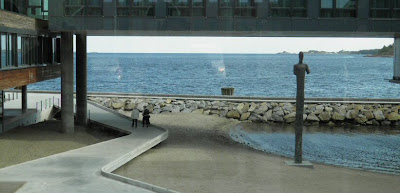
The program included 3x30-minutes parallel sessions on both of the days. Apart from learning from each other the purpose of the conference was to build network and provide opportunities for people with common interests to meet. See the conference program. Hege Hansson leaded the program (both of us have embodied experience of standing on the main stage between the speakers).

Professor of philosophy Dorthe Jørgensen from University of Aarhus, was the first keynote speaker. Her presentation about “aesthetic thinking” made a brilliant introduction to the conference theme. Two preschool teachers (Veronika Lovise Wist and Anders Skog) presented their prize-winning projects with children, and the projects were commented by Grethe Bekkevold who was a member of the jury who selected the winner for the annual national prize. Tollef Thorsnes’ large three-dimensional installations in wood and flames made the specific ambient in the main conference room.
Professor Liora Bresler, from University of Illinois, was one of the keynote speakers. With her broad knowledge about the global position of the arts (she has for instance edited the “International handbook of research in arts education”, 2007), she spoke about the specific values of the arts and how they can contribute to education.

Hillevi Lenz Taguchi from Stockholm University, spoke about intra-active pedagogy and the importance of physical materials for children’s learning.

Merete Morken Andersen, writer and colleague from Vestfold University College, spoke about the process of creating as both an individual and collective process.

Donatella De Paoli, from Norwegian Business School (BI) approached the arts education from a unique angle addressing relations between arts teaching and society from an economist’s point of view. Turid Amundsen was responsible for practical arrangement long before the conference, and had responsibilities which often appear invisible if everything functions as it should. Geir Salvesen, the dean of the Faculty of Education at the Vestfold University College (and also a music teacher) opened and closed the conference… with hopes for continuing discussions and new possibilities to meet and promote the importance of the arts.

The program included 3x30-minutes parallel sessions on both of the days. Apart from learning from each other the purpose of the conference was to build network and provide opportunities for people with common interests to meet. See the conference program. Hege Hansson leaded the program (both of us have embodied experience of standing on the main stage between the speakers).

Professor of philosophy Dorthe Jørgensen from University of Aarhus, was the first keynote speaker. Her presentation about “aesthetic thinking” made a brilliant introduction to the conference theme. Two preschool teachers (Veronika Lovise Wist and Anders Skog) presented their prize-winning projects with children, and the projects were commented by Grethe Bekkevold who was a member of the jury who selected the winner for the annual national prize. Tollef Thorsnes’ large three-dimensional installations in wood and flames made the specific ambient in the main conference room.
Professor Liora Bresler, from University of Illinois, was one of the keynote speakers. With her broad knowledge about the global position of the arts (she has for instance edited the “International handbook of research in arts education”, 2007), she spoke about the specific values of the arts and how they can contribute to education.

Hillevi Lenz Taguchi from Stockholm University, spoke about intra-active pedagogy and the importance of physical materials for children’s learning.

Merete Morken Andersen, writer and colleague from Vestfold University College, spoke about the process of creating as both an individual and collective process.

Donatella De Paoli, from Norwegian Business School (BI) approached the arts education from a unique angle addressing relations between arts teaching and society from an economist’s point of view. Turid Amundsen was responsible for practical arrangement long before the conference, and had responsibilities which often appear invisible if everything functions as it should. Geir Salvesen, the dean of the Faculty of Education at the Vestfold University College (and also a music teacher) opened and closed the conference… with hopes for continuing discussions and new possibilities to meet and promote the importance of the arts.
onsdag 29. september 2010
The Research Days
”Forskningsdagene” (the Research Days) is an annual arrangement at Norwegian universities and university collages – it is a festival that celebrate research. During the 5-6 days open presentations are held for students, employees, practitioners, and everybody who is interested to hear about (and experience) different research projects. This year’s theme was “Veien til viten” (“The way toward knowing”), which was appropriate for presentations of different research inquiries, as well as projects about educational.
 At the Vestfold University College, September 28-th 2011 was dedicated to research in arts – more precisely, to research on “aesthetic learning process”. Judging by the number of books recently published, this concept seems to be emerging in Scandinavia, but it is still new and interpreted in different ways. My short interpretation is that “aesthetic learning process” is the process of meaning making that takes place when embodied forms of learning are appreciated.
The projects presented on September 28-th were about music making and performing, theatre for those who have just learned to walk (1-2 years old), relations between different modalities in art, creating links between traditional techniques and new contexts, knitting design, search for a fiddler’s music lost in time, testing own taste, students’ explorative design with spoons ...
 I also had a chance to present my project, focusing on similarities between my own, and young children’s way toward knowing; When I was studying with 3-5 years old, their engagement with 3-D materials was as important for their learning as my engagement with them was for mine. Answering the question about ways toward knowing, I suggested that our knowledge streams through our nerve-, muscle- and blood- systems and integrates our embodied experience, mind and feelings.
All presented and exhibited project are a part of a larger umbrella project called “PES”. The “PES” gathers colleagues that teach and research in different disciplines at out teacher-education programs, and focuses on practice- , aesthetic-, and design-based approach to learning. The same interdisciplinary milieu is arranging a Scandinavian conference about “Aesthetic Learning Process” in May 2011. Welcome to send your paper proposals! http://www.hive.no/laereprosesser-konferanse/
The images:
Pål Runsjø plays inside an art instalation;
Pål Runsjø, Olav Ness, Stein Storsve, Geir Salvesen and Knut Høydal play music written by Jacob Olsen
fredag 27. august 2010
Slöjd - Learning through hands
On August 17-th and 18-th a “slöjd” conference took place in Linköping, Sweden. “Slöjd” is, among other things, a Swedish school discipline where students deal with handcraft with wood, metal and textile. In Norway the term “sløyd” is usually understood as woodwork and it is an integrated part of discipline “Arts and crafts”.
The conference was eleventh in the range of slöjd -conferences arranged each second year at the University of Linköping where people interested in slöjd: teachers, craftsmen, artists and researchers, gather to listen to the lectures, discuss at the workshops, view and experience at the exhibitions.
 The theme of this year’s conference was “Slöjd – creating, keeping and extending boundaries”. Different types of boundaries were discussed, from preserving old techniques and design on one side, to dissolution of the boundaries of school-slöjd and merging with art, on the other; Here is the conference program: http://www.trippus.se/eventus/userfiles/17691.pdf . Marléne Johansson reminded us that slöjd is both ancient, modern and “cool”. Otto von Buch showed interesting examples of intersection between sköjd and contemporary arts. In his presentation, he focused on extension of aesthetic boundaries as for example in mutual influence between old techniques and modern design, while Lars-Erik Björklund spoke about tacit knowledge, the importance of experience, and relations between brain and embodied activities.
 The participants at the conference were people who appreciated dealing with tools and materials: With their own hands they knew how valuable tacit knowledge was for them and their students. However, in a recent survey in Sweden, where students’ and their parents’ were asked to evaluate the importance of school disciplines, slöjd got almost the lowest ranking (Illum & Johansson, 2009). Teachers asked how this was possible when they frequently experience that their students enjoy the slöjd classes so much? I sensed the participants’ urge to convince school administrators, politicians and parents that human body is capable of learning in many different ways…. But what could they say? What should they say to explain and justify the importance of creating, crafting and experiencing with three-dimensional materials?
 The fate of school-slöjd is in many ways dictated by contemporary educational philosophy, politics and values in the society. How much is learning by doing, learning through experience, senses and body valued in schools today? Possibilities for such learning are also bounded by teachers’, students’ and parents’ own expectations. Such expectations, which sometimes draw back to one’s own primary school education, can grow into harmful attitudes if one doesn’t start questioning them….
What can be done to raise the status of slöjd in the society? “We need more research!”, has been said many times during the conference.
Illum, B., & Johansson, M. (2009). Vad är tillräckligt mjukt? – kulturell socialisering och lärande i skolans slöjdpraktik. FORMakademisk, 2(1), 69-82. Retrieved from http://www.formakademisk.org/index.php/formakademisk/article/view/31/26

The conference was eleventh in the range of slöjd -conferences arranged each second year at the University of Linköping where people interested in slöjd: teachers, craftsmen, artists and researchers, gather to listen to the lectures, discuss at the workshops, view and experience at the exhibitions.
 The theme of this year’s conference was “Slöjd – creating, keeping and extending boundaries”. Different types of boundaries were discussed, from preserving old techniques and design on one side, to dissolution of the boundaries of school-slöjd and merging with art, on the other; Here is the conference program: http://www.trippus.se/eventus/userfiles/17691.pdf . Marléne Johansson reminded us that slöjd is both ancient, modern and “cool”. Otto von Buch showed interesting examples of intersection between sköjd and contemporary arts. In his presentation, he focused on extension of aesthetic boundaries as for example in mutual influence between old techniques and modern design, while Lars-Erik Björklund spoke about tacit knowledge, the importance of experience, and relations between brain and embodied activities.
 The participants at the conference were people who appreciated dealing with tools and materials: With their own hands they knew how valuable tacit knowledge was for them and their students. However, in a recent survey in Sweden, where students’ and their parents’ were asked to evaluate the importance of school disciplines, slöjd got almost the lowest ranking (Illum & Johansson, 2009). Teachers asked how this was possible when they frequently experience that their students enjoy the slöjd classes so much? I sensed the participants’ urge to convince school administrators, politicians and parents that human body is capable of learning in many different ways…. But what could they say? What should they say to explain and justify the importance of creating, crafting and experiencing with three-dimensional materials?
 The fate of school-slöjd is in many ways dictated by contemporary educational philosophy, politics and values in the society. How much is learning by doing, learning through experience, senses and body valued in schools today? Possibilities for such learning are also bounded by teachers’, students’ and parents’ own expectations. Such expectations, which sometimes draw back to one’s own primary school education, can grow into harmful attitudes if one doesn’t start questioning them….
What can be done to raise the status of slöjd in the society? “We need more research!”, has been said many times during the conference.
Illum, B., & Johansson, M. (2009). Vad är tillräckligt mjukt? – kulturell socialisering och lärande i skolans slöjdpraktik. FORMakademisk, 2(1), 69-82. Retrieved from http://www.formakademisk.org/index.php/formakademisk/article/view/31/26
tirsdag 15. juni 2010
Journal Publishing
Since I’ve decided to write an article based theses, I’ve been thinking about how to organize it. I think that the articles, deriving from the same material, should build upon each other, but should not ovelap too much; They should complement one another and show the empirical material from different points of view (?)

Like a path, my study cuts across different landscapes: early childhood education and early childhood teacher education, visual arts, language development, multimodality, imagination and creativity, learning through play, studies of learning environments, sculpture and three-dimensional materials, and arts-based qualitative methods of inquiry. Since it is hardly possible to find a journal that covers all of the areas, I plan to publish in different journals, addressing different audience. I will have to work on careful planning which contents to present in each of the articles, and which kind of narrator voice to apply. In order to do that, I should need to know what my current audience (for each of the journals) would need to know more about (what they are not familiar with) and what I should need to write much about (so that they will not get bored reading about something they already know). I should take a good look at the landscape and imagine my audience…

At the Sixth Congress of Qualitative Inquiry I attended panels where journal editors presented their work and gave advice to writers. Here is what I learned from them:
Some of the journals presented on June 28-th were not specialized for qualitative studies, while others would publish qualitative studies only – A writher should know which kind of journal his study would fit best into. Some journals were method journals (like for instance the Journal of Mixed Methods Research), that would not be relevant for publishing articles that present contents of a study. Readers of method journals would rather like reading which advantages the specific research methods had in order to understand the problem that has been studied.
Dorothy Becvar (Journal of Family and Therapy) said that she is devoted to the qualitative method and wants to make sure the method is well presented. Ron Chenail (Qualitative report) encouraged writers to write in first person and in active form (not “the informants were interviewed” but “I interviewed the informants”).
Ian Shaw, University of York (Qualitative Research Work) presented his applied qualitative research journal and explained that “applied research” is about “meaning worked out in particular contexts”. When one is preparing to publish in an international journal, the article should be written in a way that it speaks across the boundaries of different contexts. Before submitting one should ask the question: Would the theme be relevant for audience outside the specific contexts? (Some things migt be relevant, others not. One should be careful where and how to step...)

Harry Torrance (British Educational Research Journal) explained that one should know that growing journals would reject the most of the articles. Donna Mertens (Journal of Mixed Method Research) gave advice that writers should always refer to articles earlier written in the journal one wants to publish in (at least two references). One should also try to find out what the editor’s, and the board member’s, research and write about. She explained what one should do when receiving two different (or even opposite) feed-backs from board-members. This happens and can be confusing. The writer might take the position of one of the reviewers, but she/he would still have to respond to the requirements from both of the reviewers in order to get published.
Janice Morse gave an editor’s perspective on how to get qualitative research published. Her angle was to present usual rejection reasons and questions to be checked before submitting: Does the article fit to the mission of the journal? Have you writing who you are (student, researcher etc.)? Is the topic exciting for others? Do you write with confidence? Do you write with enthusiasm? Do you have too few, or too many, references? If the presented project is conducted together with others, did you make explicit how much of your study ovelap with other projects? (And make sure that the people you have collaborated with are mentioned.)

Like a path, my study cuts across different landscapes: early childhood education and early childhood teacher education, visual arts, language development, multimodality, imagination and creativity, learning through play, studies of learning environments, sculpture and three-dimensional materials, and arts-based qualitative methods of inquiry. Since it is hardly possible to find a journal that covers all of the areas, I plan to publish in different journals, addressing different audience. I will have to work on careful planning which contents to present in each of the articles, and which kind of narrator voice to apply. In order to do that, I should need to know what my current audience (for each of the journals) would need to know more about (what they are not familiar with) and what I should need to write much about (so that they will not get bored reading about something they already know). I should take a good look at the landscape and imagine my audience…

At the Sixth Congress of Qualitative Inquiry I attended panels where journal editors presented their work and gave advice to writers. Here is what I learned from them:
Some of the journals presented on June 28-th were not specialized for qualitative studies, while others would publish qualitative studies only – A writher should know which kind of journal his study would fit best into. Some journals were method journals (like for instance the Journal of Mixed Methods Research), that would not be relevant for publishing articles that present contents of a study. Readers of method journals would rather like reading which advantages the specific research methods had in order to understand the problem that has been studied.
Dorothy Becvar (Journal of Family and Therapy) said that she is devoted to the qualitative method and wants to make sure the method is well presented. Ron Chenail (Qualitative report) encouraged writers to write in first person and in active form (not “the informants were interviewed” but “I interviewed the informants”).
Ian Shaw, University of York (Qualitative Research Work) presented his applied qualitative research journal and explained that “applied research” is about “meaning worked out in particular contexts”. When one is preparing to publish in an international journal, the article should be written in a way that it speaks across the boundaries of different contexts. Before submitting one should ask the question: Would the theme be relevant for audience outside the specific contexts? (Some things migt be relevant, others not. One should be careful where and how to step...)

Harry Torrance (British Educational Research Journal) explained that one should know that growing journals would reject the most of the articles. Donna Mertens (Journal of Mixed Method Research) gave advice that writers should always refer to articles earlier written in the journal one wants to publish in (at least two references). One should also try to find out what the editor’s, and the board member’s, research and write about. She explained what one should do when receiving two different (or even opposite) feed-backs from board-members. This happens and can be confusing. The writer might take the position of one of the reviewers, but she/he would still have to respond to the requirements from both of the reviewers in order to get published.
Janice Morse gave an editor’s perspective on how to get qualitative research published. Her angle was to present usual rejection reasons and questions to be checked before submitting: Does the article fit to the mission of the journal? Have you writing who you are (student, researcher etc.)? Is the topic exciting for others? Do you write with confidence? Do you write with enthusiasm? Do you have too few, or too many, references? If the presented project is conducted together with others, did you make explicit how much of your study ovelap with other projects? (And make sure that the people you have collaborated with are mentioned.)
søndag 30. mai 2010
Congress of Qualitative Inquiry
 The Sixth International Congress of Qualitative Inquiry took place at the campus of University of Illinois, Urbana-Champaign from May 26-th to 29-th. About 700 participants from around the world took part in large number of presentation, plenary and poster sessions. I will be writing more about the congress, but since I am publishing this blog on my way back to Norway, it will be just a short note about my own presentation on Friday May 28-th.
It is difficult to say much in short time: you have to present the contexts of your work so that your intentions would be understood, you have to say something relevant and important, you should say it in a way that makes the listeners interested, and you will have to sum up - or open up for further reflection. And all that in 12 minutes! Usually when I present I use many visual images. (This time the children’s parents had even allowed me to use films of their children.) But 12 minutes would be too short to sett up a projector, show the images and still have time to explain, discuss and tell about my lived experiences. I decided to write down what I should say, edit the paper again and again in order to make it shorter and more intense, and practice reading it in order to be able to look at audience while I was reading. Later, I was apologizing to Liora Bresler that I was reading while addressing the issue of multimodal communication and body language: “What a contradiction between the content and the form!” But Liora calmed me down: “That’s just how conference genre is!”
 This is an image of me with Norwegian colleague Ingrid Grønsdal Arnesen outside the Union building.
And here is the abstract that can illustrate what I was talking about:
Intersubjectivity, Interpretation and Improvisation: How Three-Year-Old Students Challenge Researchers’ Competence
A PhD study of children’s meaning making during explorative play with sculpturing materials conducted by an art teacher/practitioner-researcher in a Norwegian early childhood center. The form of inquiry was inspired by A/R/Tography (Irwin 2004), involving video-recording of own activity with children. Children’s highly imaginative and multimodal forms of communication have challenged the researcher’s ability to create immediate and appropriate responses to the children’s creative verbal and non-verbal contributions. If we respect young children, value their way of living and want them to become self-confident individuals, research methods in early childhood education must respond to their expressive ways of democratic participation.
fredag 23. april 2010
NAEA’s Convention 2010
This year’s (American) National Art Education Association’s (NAEA) national convention took place in Baltimore, Maryland, USA from April 14-th to 18-th. Over 4000 art educators and researchers were gathered at the Baltimore Convention Center to learn from each other. The title of the convention connected art education and social justice. Together with the logo, showing a fist clenching around brushes, the conference title “Art Education and Social Justice” was a powerful message and invitation to make visible how art education can promote social justice, addressing not only art teachers and researchers, but also educational policy makers.
 I attended many of the sessions carried out by the Early Childhood Art Educators interest group (ECAE): “Re-Centering the Child: Mindful Arts Practices in Early childhood” on Friday, “Living the vision: Early Childhood Art education in Troubling Times - The child’s right to Artistic expression” on Saturday and “Living the vision: Early Childhood Art education in Troubling Times - Art: essential for early learning” on Thursday. My own session also addressed children’s artistic activities as essential for early learning (meaning making).
The title of my presentation was “Reflection about Sculpturing Materials – Foundation for Development of Aesthetic Competence and Meaning Making”. In hope to be able to visualize the complex and merging processes that I experienced took place during my co-researchers’ (children 3-5) play with three-dimensional materials, I designed and presented a visual model. The model’s main parts were illustrating: 1) specifications of the contexts where children’s play with three-dimensional materials took place; 2) children’s experiencing activities; 3) materials possibilities; 4) materials limitations. (I don’t think I should say much more about this before publishing – and those who have asked me to use my model will unfortunately also have to wait).
 One of the best things with attending a conference is that one can meet other researchers and practitioners, and can learn which kinds of interests and issues are emerging in the field. At least it was very important for me to experience that I was not alone in understanding children, arts and meaning making the way I do! I met others with familiar interests and realized that my project is somehow related to an emerging field that celebrates imagination, embodied meaning making, lived curricula, relational pedagogy and experience with materials:
- I listened to Charles Garoian’s fascinating presentation about embodied practice of art – exemplified through a practice narrative where 3D materials were even digested.
- I heard Linda Lewis say that possibilities for representation are inherent in materials.
- Rita Irwin showed me how we all have something to learn one from another.
- Alice Arnold remanded me about issues of globalization that influence cultural meanings, art and education.
- The winner of Manuel Barkan Award, Donal O’Donoghue, convinced me how relational acts of art are.
- Margaret Macintyre Latta emphasized how essential play is –something I completely agree with her on.
- I listened to Lars Lindstrøm, the winner of the 2010 USSEA Ziegfeld International Award, presenting a Scandinavian project about creativity.
- And I met Heidi Davis who shared many of my interests: sculpturing materials, meaning making and respect for children’s imaginative ways of knowing. It was a lucky coincidence that I met Heidi… again…!
Last time I met Heidi, it was in Vancouver July 2009. She presented a paper about young children and sculpture which I attended, we exchanged a coupe of words during the conference, and that was it. Almost a year later we met again. I had just missed her presentation, but she came to see mine. When we later met for a coffee, we both understood how familiar our projects are and that we should not rely on coincidence any more, but with own wish and will keep in touch!
 There was another coincidence which I find even more peculiar… It is about my meeting with Maureen (or Marina, as her husband calls her), K-3 art educator (which means that she teaches 5-9 years old children). She was occasionally sitting beside me at the convention’s first general session (when Liora Bresler, and three other ladies, received NAEA’s Distinguished Fellow Award). When we started a conversation, she asked me where I had my accent from. I said: “From Norway, but probably also from my mother tongue, Serbian, as well.” She stared at me for a second and started to speak Serbian! She was American, but her husband was from the same million-people-city I originally come from. And as if this was not remarkable enough, after a few hours of talk later that day about teaching and other things, we found out that her husband attended the same middle and high school as I did, and lived in the neighbouring street… 30 years ago!
I do not want to sound superstitious, but how large were the statistical possibilities for meeting Heidi and Maureen? I am sure that all of us sometimes experience coincidences (or whatever we call them) - sometimes we don’t notice them, other times they even change our lives. A friend, practicing psychodrama, has often reminded me that only when we open our eyes we will be able to see... and when we open palms of our hands, we will be able to embrace new possibilities.
We sometimes need to clench our fists in order to hold directions toward our goals, but we also need to open our hands in order to welcome jet unimagined possibilities …
 I attended many of the sessions carried out by the Early Childhood Art Educators interest group (ECAE): “Re-Centering the Child: Mindful Arts Practices in Early childhood” on Friday, “Living the vision: Early Childhood Art education in Troubling Times - The child’s right to Artistic expression” on Saturday and “Living the vision: Early Childhood Art education in Troubling Times - Art: essential for early learning” on Thursday. My own session also addressed children’s artistic activities as essential for early learning (meaning making).
The title of my presentation was “Reflection about Sculpturing Materials – Foundation for Development of Aesthetic Competence and Meaning Making”. In hope to be able to visualize the complex and merging processes that I experienced took place during my co-researchers’ (children 3-5) play with three-dimensional materials, I designed and presented a visual model. The model’s main parts were illustrating: 1) specifications of the contexts where children’s play with three-dimensional materials took place; 2) children’s experiencing activities; 3) materials possibilities; 4) materials limitations. (I don’t think I should say much more about this before publishing – and those who have asked me to use my model will unfortunately also have to wait).
 One of the best things with attending a conference is that one can meet other researchers and practitioners, and can learn which kinds of interests and issues are emerging in the field. At least it was very important for me to experience that I was not alone in understanding children, arts and meaning making the way I do! I met others with familiar interests and realized that my project is somehow related to an emerging field that celebrates imagination, embodied meaning making, lived curricula, relational pedagogy and experience with materials:
- I listened to Charles Garoian’s fascinating presentation about embodied practice of art – exemplified through a practice narrative where 3D materials were even digested.
- I heard Linda Lewis say that possibilities for representation are inherent in materials.
- Rita Irwin showed me how we all have something to learn one from another.
- Alice Arnold remanded me about issues of globalization that influence cultural meanings, art and education.
- The winner of Manuel Barkan Award, Donal O’Donoghue, convinced me how relational acts of art are.
- Margaret Macintyre Latta emphasized how essential play is –something I completely agree with her on.
- I listened to Lars Lindstrøm, the winner of the 2010 USSEA Ziegfeld International Award, presenting a Scandinavian project about creativity.
- And I met Heidi Davis who shared many of my interests: sculpturing materials, meaning making and respect for children’s imaginative ways of knowing. It was a lucky coincidence that I met Heidi… again…!
Last time I met Heidi, it was in Vancouver July 2009. She presented a paper about young children and sculpture which I attended, we exchanged a coupe of words during the conference, and that was it. Almost a year later we met again. I had just missed her presentation, but she came to see mine. When we later met for a coffee, we both understood how familiar our projects are and that we should not rely on coincidence any more, but with own wish and will keep in touch!
 There was another coincidence which I find even more peculiar… It is about my meeting with Maureen (or Marina, as her husband calls her), K-3 art educator (which means that she teaches 5-9 years old children). She was occasionally sitting beside me at the convention’s first general session (when Liora Bresler, and three other ladies, received NAEA’s Distinguished Fellow Award). When we started a conversation, she asked me where I had my accent from. I said: “From Norway, but probably also from my mother tongue, Serbian, as well.” She stared at me for a second and started to speak Serbian! She was American, but her husband was from the same million-people-city I originally come from. And as if this was not remarkable enough, after a few hours of talk later that day about teaching and other things, we found out that her husband attended the same middle and high school as I did, and lived in the neighbouring street… 30 years ago!
I do not want to sound superstitious, but how large were the statistical possibilities for meeting Heidi and Maureen? I am sure that all of us sometimes experience coincidences (or whatever we call them) - sometimes we don’t notice them, other times they even change our lives. A friend, practicing psychodrama, has often reminded me that only when we open our eyes we will be able to see... and when we open palms of our hands, we will be able to embrace new possibilities.
We sometimes need to clench our fists in order to hold directions toward our goals, but we also need to open our hands in order to welcome jet unimagined possibilities …
torsdag 17. desember 2009
Intersubjectivity, Interpretation and Improvisation
I’ve got a mail (from Norm Denzin) confirming that my submission to the The Sixth International Congress of Qualitative Inquiry has been accepted. The congress will take place in Urbana-Campaign, Illinois, USA May 26-29. 2010… So I still have some time to prepare the presentation.
Here is the abstract that has been sent, with title: Intersubjectivity, Interpretation and Improvisation: How Three-Year-Old Students Challenge Researchers’ Competence
A PhD study of children’s meaning making during explorative play with sculpturing materials conducted by an art teacher/practitioner-researcher in a Norwegian early childhood center. The form of inquiry was inspired by A/R/Tography (Irwin 2004), involving video-recording of own activity with children. Children’s highly imaginative and multimodal forms of communication have challenged the researcher’s ability to create immediate and appropriate responses to the children’s creative verbal and non-verbal contributions. If we respect young children, value their way of living and want them to become self-confident individuals, research methods in early childhood education must respond to their expressive ways of democratic participation.

"Walking a log": I was hoping that he would sit on it, but the boy rather wanted to take it for a walk.
Here is the abstract that has been sent, with title: Intersubjectivity, Interpretation and Improvisation: How Three-Year-Old Students Challenge Researchers’ Competence
A PhD study of children’s meaning making during explorative play with sculpturing materials conducted by an art teacher/practitioner-researcher in a Norwegian early childhood center. The form of inquiry was inspired by A/R/Tography (Irwin 2004), involving video-recording of own activity with children. Children’s highly imaginative and multimodal forms of communication have challenged the researcher’s ability to create immediate and appropriate responses to the children’s creative verbal and non-verbal contributions. If we respect young children, value their way of living and want them to become self-confident individuals, research methods in early childhood education must respond to their expressive ways of democratic participation.

"Walking a log": I was hoping that he would sit on it, but the boy rather wanted to take it for a walk.
torsdag 17. september 2009
Children’s consent, or not?
 The title of this year’s EECERA-conference (held in Strasbourg, August 26th-29th ) was Diversities in Early Childhood Education, and the theme involved many different kinds of diversity: language, social situation, disability, gender, and also methodological diversity in research with young children. My presentation was about diversity in children’s expressive languages (and merging of the languages during children’s play 3D materials), but I wish to write about something else here – some reflections about children’s consent in research.
I attended the parallel session “Qualitative research – revolutions of continuing tensions?” where one of the presentations was: “Children should be involved in research design: even in early years?” by Lorna Savage and Muriel Logan, form Stirling Institute of Education. Some of the addressed questions were how to involve “the competent child” in the research process and design, and “whether early years children have adequate skills and research training to be included in the design process”.
 At the same time, one of my colleagues attended another presentation which was about children’s consent and “research contracts” in form of drawings. When we occasionally met that sunny afternoon, we exchanged our experiences form the presentations. This made me think about ethical challenges when I, as a researcher, see a child as both competent and fragile in the same time. I believe that we have to be attentive to the children’s voices (also when they are silent), but isn’t is something completely different to ask them a questions like: “Is it OK for you that I take pictures of you and put them on the internet?”? Can we expect a child to consider all consequences before giving us the answer? Probably not…
 What scares me here is that it is possible to be superficial: ask a direct question, and later say that the child has been informed and has given her/his consent (one can even show a contract). But how ethical is it misuses the child’s impossibility to understand complex questions about research and ethics? We can’t be serious to believe that a four year old would understand what “research” means? The complexity of a question is not about how easy it is to give an answer (like in “yes-no questions”), but in the thick levels of consequences that lay behind.
fredag 24. juli 2009
Imaginative Education at Simon Fraser University in Vancouver
 The 7th International Conference on Imagination and Education was my second and at least as inspiring as the last summer’s! The keynote speaker Dr. Eleonor Dunckworth suggested in her plenary session that one should go where one can be found, and that is exactly what I did: I went to Vancouver “to be found” by those who share my interests in imaginative education, and see arts and imagination as sources of creativity and invention. And I found many kindred souls who share a vision that it is possible to “build a better world by thinking of the possible, not just the actual” – as the conference title suggested. (Read more about the conference)
I met Dr. Kieran Egan (se the photo below), the man with great ideas and the driving force behind the IERG and the conference on imagination and education. I appreciate that he chose to come to my presentation also this year. I also appreciate that people spoke to me after my presentation –This is how I met Kerrie Bellisario from Lesley University in New York who spoke about arts-integration as “universal design for learning” for students of all ages, and arts, creativity and imagination as important part of “21 century skills”.
 I met, and became a friend with, Liudmila Gusteva from Magnitogorsk State University situated on the river Ural, exactly at the border between Europe and Asia. She presented Leonid Zankov’s educational system directly related to his teacher’s (Vygotsky’s) work, and especially to “the zone of proximal development”. She invited me to the conference at her university in November this year (with submission September 10th ).
 I met Marni Binder and Sally Kotsopoulos form the School of Early Childhood Education in Toronto, who share my interests in visual arts and teaching student how to foster children’s imagination, creativity and play. Fortunately, these two wonderful lades are also coming to the EECERA conference in France this August, where I hope to meet them again!
I met Prof. Gradir Cadral form Criciuma in Brazil who told us about the interesting concept of the Museum of Childhood – a museum without walls, where visiting children are involved in re-interpretation, “museumization” and creation of the exhibition objects.
And I met Heidi Davis form Indiana University who spoke warmly about sculpture as “playground for the imagination”, and Milena Droumeva from Simon Fraser University (SFU) who took us to a “sound walk” in the streets of avncouver, and many other most imaginative and inspiring people!
 During the closing session, Mark Fettes form SFU expressed his hopes that imagination will be given a larger importance in upbringing and education around the world. He said: “imagination is re-emerging on the educational scene as a significant concept”. But his words also reminded us that “the lack of theoretical and philosophical coherence undermines its (imagination’s) impact in the field (education)” and in a way invited us to continue with research that can show why and how imagination is essential for learning and development.
tirsdag 20. januar 2009
Arts and Education

Last week I attended the first part of the course Aesthetic-Based Qualitative Research, at the Stockholm University, held by the visiting professor Liora Breslar.
We were app. 20 people attending the course, almost all of us in some way involved with art education: dance, music, drama or visual arts, and some are practicing artists. We didn't know each other, but we were all there to learn, eather students at master level, or at PhD level. I've never before enjoyed a course so much, and I wonder: What made these three days so special?
The main theme was qualitative research in art education, but the issue of artistic qualities in teaching was also mentioned... or rather shown through the Liora's teaching method.
Preparing for the course, I read the first two chapters of "Number Our Days", written by Barbara My
 erhoff, that Liora had suggested. I was sitting on a bus, reading... and crying, and I immediately understood that the three days with Liora Bresler would be special. The text I was reading was from a case of antropological study, written in a poetic way, but still educating, meaningful and full of wisdom. I thought: "Some researchers are artists, able to present their work in artistic ways." And there are also teachers who transform their lessons into compositions, combining planning and improvisation, or sometimes, "guided by aesthetic principles with a dramatic structure" such teachers manage to "create(-d) a meaningful artistic lesson" (to quote Liora Bresler the way she described Joe Herbert, a teacher she observed in a school in Danville - Bresler 1991) May be it was Liora's expressive way of communication that created the context for my unique experience during her lectures?
In the begynning of the class Liora asked us to pay attention to what was happening in the room - to be observers involved in a kind of micro qualitative research. This first day of the course we sat in an auditorium (the second day we were at the Moderna Museet - The Museum of Mode
 rn Art, and the third day we sat in a circle formation in a drama room at the university). Thinking about teaching as art, and knowing that Liora also is a musician, I paid attention to her voice, ways of addressing us, her body language, gestures... - multimodal communication. I noticed the rhythm of her movements: slowly walking from side to side in front of us, establishing eye contacts, and involving everyone. "It was comfortable to be included", I thought: "this way she gathers the group". At the end of the day we were asked to present our observations: Liora wanted to exemplify relations between description, interpretation and evaluation in qualitative research.
When I started to articulate my observations of Liora's rhythmical walking, a methaphor of a dog shepherding it's sheep (us, students) came out of my mouth. I immediately thought: "Oh...how could I say something like this? I actually called professor a dog!!" Later on, when we were interpreting the "shepherding attitude", I tried to shade my metaphor: "May be the metaphor i
 s not that good", I said. "You really do not use your authority, like a shepherd would do with it's sheep. May be your movements were more like (using a methaphor from dog training again) when a dog doesn't want to come, and you run away to get it's attention?" But it was not possible to make the said unsaid. On the other hand, it seemed that Liora liked the image of a shepherd - she mentioned it a couple of times during the day: "Sometimes I even have to bite to get attention", she smiled.
Today, a week later, I believe that the way of communication at the course was of an essencial importance for my positive experience: We were invited to take part. We were laughing, having fun - and we were equal in "democratic conversations" (see my blog from the 9-th of January). We all had something to learn from each others, and something to contribute with. We were taken seriously (but, though, not in a serious way). Liora's appreciation of our contributions was honest, we all reflected together and Liora didn't hide that she was learning form us! The teaching and the respect were mutual.
I've just read an artilcle about written by Mary Fawcett and Penny Hay, abouth a project with Reggio Emilia approach in UK (Fawcett & Hay 2004), where some of findings were that respect for a child's multiple ways of expression builds it's confidence, and is a motivating force in their problem solving, cerativity and learning. We are not that different form children, after all :)
The pictured sculptures are a part of the oudoor installation PARADISE, made by Niki De Saint Phalle and Jean Tinguely, placed outside the Moderna Museet in Stockholm.
søndag 7. desember 2008
Evolution of The Human Hand
 I attended a research seminar on Research by Design at AHO (The Oslo School of Architecture and Design) on the 4-th of December. The theme itself was not so relevant for my research, but was for me personally. Sometimes during the presentations, I caught my thoughts on their way to somewhere… One can blame on my associations that from time to time spin off in the unknown directions... and take me with them.
Professor Michael Weinstock spoke about evolution, and professor Michael Hensel showed some beautiful extremely enlarged images of plants, and there I was thinking about children’s biological predispositions for learning. I was thinking about evolution of human kind: how the form of the human hand had made it possible to use tools, something that made us different from the most of other animals. Being able to handle physical object demanded more brain activity and advanced thinking. With being able to walk on two feet, two hands were free to use also during walking (this was important before hands free telephone accessories). This brought me further in thinking about importance of physical environment, and use (or misuse) of tools and other artefact in our learning. I see clearly now where this was going! My associations were taking me strait to my PhD-project: to children’s handling of physical three dimensional materials. I might have to look into evolutional studies of human beings to find explanations for “learning through hands”?
Abonner på:
Innlegg (Atom)